Minimum order value ₹99.00 · Get 10% Off on Cart Value use Coupon code VASP10 · Free shipping over ₹999.00


Power MOSFET Review and Comparison Guide

Power MOSFETs are widely used in switching power supplies, motor drivers, solar charge controllers, audio amplifiers, DC-DC converters, and many other power electronics systems. Their popularity comes from fast switching speed, high efficiency, and simple voltage-controlled operation.
This review examines commonly used MOSFETs across different voltage and current classes. The devices included represent several major application groups:
- High-voltage MOSFETs for SMPS and power supplies
- Low-voltage high-current MOSFETs for motor control and DC switching
- MOSFETs used in solar charge controllers
- Audio-grade MOSFETs used in power amplifier output stages
MOSFET Basics
A MOSFET (Metal-Oxide-Semiconductor Field-Effect Transistor) is a voltage-controlled device where current between the Drain and Source is controlled by voltage applied to the Gate.
Key parameters that determine MOSFET performance include:
Drain-Source Voltage (VDS)
Maximum voltage the device can block.
Drain Current (ID)
Maximum continuous current the MOSFET can conduct.
On-Resistance (RDS(on))
Resistance between drain and source when fully turned on. Lower values reduce conduction losses.
Gate Charge (Qg)
Total charge required to switch the MOSFET. Lower gate charge enables faster switching.
Safe Operating Area (SOA)
Defines safe limits of current and voltage during operation.
MOSFET Comparison Table
| MOSFET | Type | VDS | ID | RDS(on) | Package | Typical Applications |
|---|---|---|---|---|---|---|
| 2N65 | N-channel | 650 V | ~5 A | ~2–3 Ω | TO-220 | SMPS primary switching |
| IRF9Z34 | P-channel | −55 V | −19 A | ~0.14 Ω | TO-220 | Load switching, solar controller outputs |
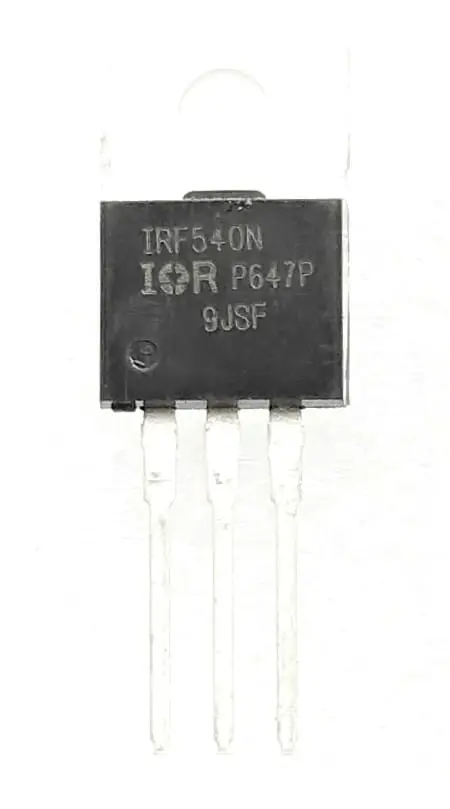
| IRF540N | N-channel | 100 V | 33 A | ~0.044 Ω | TO-220 | Motor drivers, solar controllers |
| IRF640N | N-channel | 200 V | 18 A | ~0.18 Ω | TO-220 | Power converters |
| IRF3205 | N-channel | 55 V | 110 A | ~0.008 Ω | TO-220 | Solar charge controllers, inverters |
| IRF4905 | P-channel | −55 V | −74 A | ~0.02 Ω | TO-220 | Battery load switching |
| IRF9540N | P-channel | −100 V | −23 A | ~0.117 Ω | TO-220 | Audio amplifiers, switching circuits |
| IRF9640 | P-channel | −200 V | −11 A | ~0.5 Ω | TO-220 | High-voltage analog circuits |
| IRFP250N | N-channel | 200 V | 30 A | ~0.075 Ω | TO-247 | Power amplifiers, converters |
| IRFP240 | N-channel | 200 V | 20 A | ~0.18 Ω | TO-247 | Hi-Fi amplifier output stage |
| IRF9240 | P-channel | −200 V | −11 A | ~0.5 Ω | TO-3 | Audio amplifiers |
| IRFZ44 | N-channel | 60 V | 50 A | ~0.028 Ω | TO-220 | Motor control, solar controllers |
| 10N80 | N-channel | 800 V | 10 A | ~0.95 Ω | TO-3P | High-voltage SMPS |
| 5N65 | N-channel | 650 V | 4.5 A | ~2.4 Ω | TO-220 | Flyback converters |
High-Voltage MOSFETs (SMPS Applications)
High-voltage MOSFETs are designed for switch-mode power supplies, flyback converters, and offline power circuits.
- 10N80
- 2N65
- 5N65
These devices typically support 650–800 V drain-source voltage and moderate current levels. They are optimized for switching performance rather than extremely low conduction losses.
Low-Voltage High-Current MOSFETs
These MOSFETs are optimized for very high current with low RDS(on).
- IRF3205
- IRFZ44
- IRF540N
Such devices are commonly used in motor controllers, battery systems, inverters, and DC-DC converters where conduction efficiency is important.
MOSFETs in Low Voltage Solar Charge Controllers
Solar charge controllers regulate the charging process between a solar panel and a battery. In modern controllers, MOSFETs act as the main electronic switches that control how energy flows from the solar panel to the battery and from the battery to the load.
MOSFETs are preferred in solar charge controllers because they provide high efficiency, low switching losses, and fast response. Unlike relays, MOSFETs allow silent operation, high switching frequency, and precise electronic control.
Charging Control Using N-Channel MOSFETs
In most PWM solar charge controllers, N-channel MOSFETs regulate the charging current from the solar panel to the battery. The controller rapidly switches the MOSFET on and off using pulse width modulation (PWM) to maintain the correct charging voltage.
For 12 V and 24 V solar systems, the MOSFET must handle high current while maintaining very low on-resistance to minimize power loss and heat generation.
Examples include:
- IRF3205 — 55 V, 110 A MOSFET widely used in solar charge controllers due to extremely low RDS(on) and high current capability.
- IRFZ44 — 60 V, 50 A MOSFET commonly used in medium-power solar charge controllers.
- IRF540N — 100 V MOSFET that provides additional voltage margin for larger solar arrays.
These MOSFETs provide efficient switching and low conduction losses, which is important because solar charge controllers often operate continuously for long periods.
Load Switching Using P-Channel MOSFETs
Many solar charge controllers include a load output used to power lights or small DC appliances. This output is typically protected by a MOSFET switch that disconnects the load when the battery voltage becomes too low.
In these circuits, P-channel MOSFETs are commonly used as high-side switches because they simplify the control circuitry. The controller can turn the load on or off by driving the gate voltage relative to the battery voltage.
Examples include:
- IRF4905 — −55 V, −74 A P-channel MOSFET suitable for high-current load switching.
- IRF9540N — −100 V P-channel MOSFET used in moderate-power switching circuits.
- IRF9Z34 — −55 V MOSFET suitable for smaller load outputs in compact controllers.
Using P-channel MOSFETs for load switching allows the controller to disconnect the load quickly during undervoltage conditions, protecting the battery from deep discharge.
Why MOSFET Selection Matters in Solar Controllers
The MOSFETs used in solar charge controllers directly affect efficiency, reliability, and thermal performance.
- Low RDS(on) to minimize heat generation
- Adequate voltage rating for panel and battery voltages
- High current capability for charging and load currents
- Good thermal performance when mounted to heatsinks
Careful MOSFET selection ensures efficient energy transfer from the solar panel to the battery while protecting the battery and load circuits.
Audio Power MOSFETs
Certain MOSFETs are widely used in high-fidelity audio amplifier output stages.
- IRFP240
- IRFP250
- IRF9240
- IRF9540
These devices provide good linearity and a wide safe operating area, making them suitable for analog amplifier designs.
Package Types
Several package types appear in this group of devices.
- TO-220 – common for medium-power devices
- TO-247 – used for higher power dissipation
- TO-3 – metal package used in older amplifier designs
- TO-3P – larger package used for high-voltage switching MOSFETs
Larger packages provide improved thermal performance and allow higher power dissipation when mounted on proper heatsinks.
Selecting the Right MOSFET
When choosing a MOSFET for a design, engineers typically evaluate:
- Voltage rating (VDS)
- Current rating (ID)
- On-resistance (RDS(on))
- Gate charge (Qg)
- Package and thermal resistance
The selected MOSFET should always have a voltage rating comfortably above the expected operating voltage and a current rating that allows safe operation with thermal margin.
Conclusion
Power MOSFETs are essential components in modern electronics, enabling efficient switching and power control across a wide range of applications.
The devices reviewed here demonstrate the broad spectrum of MOSFET capabilities, from high-voltage SMPS devices to high-current switching transistors, solar charge controller switches, and audio amplifier components.
Selecting the correct device requires balancing voltage rating, current capability, switching speed, and thermal performance to ensure reliable circuit operation.
FAQ
What is a power MOSFET used for?
Power MOSFETs are used in switching power supplies, solar charge controllers, motor drivers, DC-DC converters, and audio amplifiers. They allow efficient control of high current and voltage using a small gate control signal.
What is the difference between N-channel and P-channel MOSFETs?
N-channel MOSFETs conduct when the gate voltage is higher than the source voltage and usually provide lower resistance and higher efficiency. P-channel MOSFETs conduct when the gate voltage is lower than the source and are commonly used for high-side switching applications.
Which MOSFETs are commonly used in solar charge controllers?
Low-voltage high-current MOSFETs such as IRF3205, IRFZ44, and IRF540N are commonly used in solar charge controllers. These devices offer low RDS(on) and high current capability, which helps reduce power loss during battery charging.
Why are P-channel MOSFETs used in solar charge controller load outputs?
P-channel MOSFETs such as IRF4905, IRF9540N, or IRF9Z34 are often used as high-side switches for the load output in solar charge controllers. They allow the controller to disconnect the load when the battery voltage drops below a safe level.
What does RDS(on) mean in a MOSFET?
RDS(on) is the drain-to-source resistance of the MOSFET when it is fully turned on. Lower RDS(on) values reduce power loss and heat generation, which improves efficiency in high-current applications.
How do you choose the right MOSFET for a circuit?
The correct MOSFET is selected by considering the required drain-source voltage rating, current rating, on-resistance, gate charge, and thermal characteristics. The device should have enough voltage and current margin to operate safely under load.