Minimum order value ₹99.00 · Get 10% Off on Cart Value use Coupon code VASP10 · Free shipping over ₹999.00


Speaker Protection Boards Review & Comparison

Speaker Protection Boards – Practical Comparison
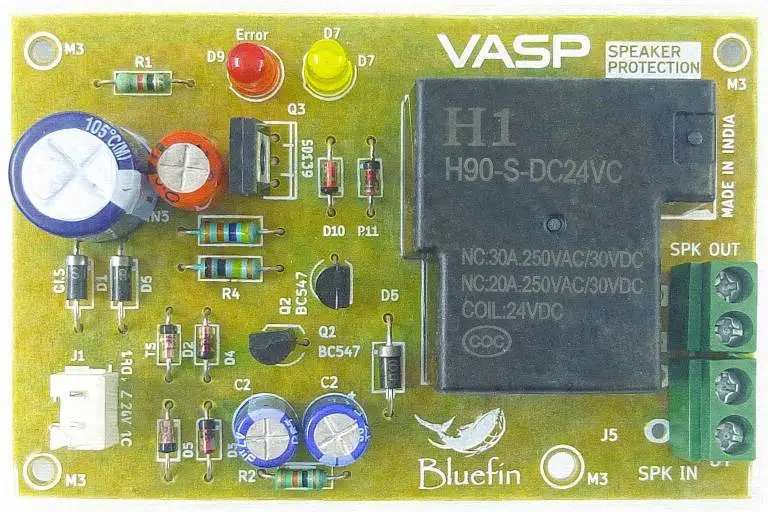
This review compares three speaker protection boards designed to prevent damage to speakers from DC faults and power-on/off transients. These boards are installed between the amplifier output and speaker load and are essential for protecting expensive speakers in DIY and high-power audio systems.
1. 12V 10A Stereo Speaker Protection Board
Product Link:
View Product
Position: Basic stereo protection for low to mid power systems
- Supply: 0–12V AC
- Current: up to 10A
- Dual-channel (stereo support)
- Turn-on delay: ~2–5 seconds
- DC detection: ~2V threshold
Pros:
- Supports stereo amplifiers (2 channels)
- Longer delay improves protection during startup
- LED indicators for status and fault
- Simple and reliable design
Cons:
- Limited current capacity (not for high-power amps)
- Basic relay type
2. 12V 30A Speaker Protection Board
Product Link:
View Product
Position: High-current protection for powerful amplifiers
- Supply: 0–12V AC
- Current: up to 30A
- Relay: L90 / H90 T-type
- Turn-on delay: ~1–2 seconds
- DC detection: ~2V threshold
Pros:
- High current handling for large amplifiers
- Strong relay design
- Suitable for subwoofer and high-power systems
- Status LEDs included
Cons:
- Shorter delay compared to 10A version
- Single-channel use (typically one amplifier line)
3. 24V 30A Speaker Protection Board
Product Link:
View Product
Position: High-current protection for higher-voltage systems
- Supply: 0–24V AC
- Current: up to 30A
- Relay: L90 / H90 T-type
- Turn-on delay: ~1–2 seconds
- DC detection: ~2V threshold
Pros:
- Supports higher voltage relay systems
- High current capacity
- Suitable for large amplifier setups
- Reliable fault detection
Cons:
- Requires 24V AC supply
- Not needed for low-power systems
Comparison Summary
| Board | Channels | Current | Supply | Best Use |
|---|---|---|---|---|
| 12V 10A | Stereo | 10A | 12V AC | Home audio (low-mid power) |
| 12V 30A | Mono | 30A | 12V AC | High-power amplifiers |
| 24V 30A | Mono | 30A | 24V AC | High-voltage systems |
Final Conclusion
- Choose 12V 10A stereo board for standard home audio systems
- Choose 12V 30A board for high-power amplifiers and subwoofers
- Choose 24V 30A board when your system uses higher relay supply voltage
Speaker protection boards are critical for preventing damage caused by DC offset and switching transients. The right choice depends on amplifier power and relay supply voltage, not just the number of channels.
Frequently Asked Questions (FAQ)
1. What does a speaker protection board do?
A speaker protection board disconnects the speaker from the amplifier during power-on/off and when DC voltage is detected, preventing damage.
2. Why is DC protection important?
DC voltage at the amplifier output can permanently damage speakers. The protection board detects DC and prevents the relay from connecting the speaker.
3. What is turn-on delay in speaker protection boards?
Turn-on delay (typically 1–5 seconds) prevents speaker “pop” noise during amplifier startup by delaying the relay connection.
4. Which protection board should I choose: 10A or 30A?
Use 10A boards for standard home audio systems. Use 30A boards for high-power amplifiers and subwoofer systems requiring higher current handling.
5. Can I use a stereo protection board with a mono amplifier?
Yes. A stereo board can be used for mono by using one channel, but it is typically designed for dual-channel (left/right) systems.
6. What power supply is required for these boards?
These boards require an AC supply (typically 12V or 24V AC) from a step-down transformer to drive the relay circuit.
7. Do speaker protection boards affect audio quality?
No. When properly designed, they do not affect audio quality as they only control the relay connection between amplifier and speaker.
8. Are speaker protection boards necessary?
Yes, especially for high-power amplifiers. They protect speakers from DC faults and switching transients, which can otherwise cause permanent damage.


