Minimum order value ₹99.00 · Get 10% Off on Cart Value use Coupon code VASP10 · Free shipping over ₹999.00

Audio Operational Amplifiers Review

Audio Operational Amplifiers – Fundamentals and Core ICs Review (Part 1)
Operational amplifiers (op-amps) are the backbone of analog audio electronics. They are used for signal amplification, filtering, mixing, buffering, and tone shaping in everything from portable devices to high-fidelity audio systems. This section focuses on the fundamental working principles of op-amps and introduces three widely used ICs: NJM4558, LM358, and LM324.
What is an Operational Amplifier?
An operational amplifier is a high-gain differential voltage amplifier that amplifies the difference between two input signals. It consists of two inputs:
- Non-inverting input (+)
- Inverting input (−)
The output is proportional to the voltage difference between these inputs, multiplied by a very high gain factor. In practical circuits, external feedback networks are used to control gain, bandwidth, and stability.
In audio systems, op-amps are typically used in:
- Preamplifiers
- Active filters (low-pass, high-pass, band-pass)
- Equalizers and tone control circuits
- Mixers and summing amplifiers
- Buffer stages and impedance matching
NJM4558 / 4559 – Classic Audio Dual Op-Amp
The NJM4558 is one of the most widely used dual operational amplifiers in audio circuits, especially in analog audio equipment such as mixers, guitar pedals, and Hi-Fi systems. It is based on bipolar transistor technology and is optimized for stable analog performance.
Key Characteristics:
- Dual op-amp configuration (2 amplifiers in one IC)
- High voltage gain (~100 dB typical)
- High input resistance (~5 MΩ)
- Low noise performance suitable for audio
- Good channel matching for stereo applications
According to the datasheet, the NJM4558 operates with supply voltages up to ±18 V and provides a typical gain-bandwidth product of around 3 MHz :contentReference[oaicite:0]{index=0}. Its slew rate is about 1 V/µs, making it suitable for general-purpose audio amplification but not for high-speed or ultra-high-fidelity applications.
The internal structure (shown in the equivalent circuit on page 1) uses a bipolar differential input stage followed by gain stages and output buffering, which contributes to its warm and stable audio characteristics :contentReference[oaicite:1]{index=1}.
Typical use cases:
- Audio preamplifiers
- Guitar effects pedals (overdrive/distortion circuits)
- Analog mixers
- Tone control circuits
LM358 / LM2904 – Low Power Single-Supply Op-Amp
The LM358 is a dual operational amplifier designed for low-power and single-supply operation. It is widely used in battery-powered and embedded systems but also appears in basic audio applications where efficiency is more important than high fidelity.
Key Characteristics:
- Dual op-amp configuration
- Single supply operation: 3 V to 32 V
- Input common-mode range includes ground
- Low power consumption (~0.5 mA typical)
- Short-circuit protected outputs
One of its major advantages is that the input and output can operate close to ground, which simplifies circuit design in single-supply systems :contentReference[oaicite:2]{index=2}. This eliminates the need for dual power rails in many applications.
From the electrical characteristics (page 4), the LM358 has:
- Open-loop gain ~100 V/mV
- Output current up to ~45 mA (source)
- Common-mode range up to VCC − 1.7 V
The internal schematic (page 2) shows a two-stage amplifier with differential input transistors and internal compensation, designed for stability and low power rather than high-speed performance :contentReference[oaicite:3]{index=3}.
Typical use cases:
- Battery-powered audio circuits
- Simple audio amplifiers
- Signal conditioning stages
- Sensor and control circuits with audio output
Limitations:
- Low slew rate (~0.3 V/µs typical)
- Not suitable for high-frequency or high-fidelity audio
- Limited bandwidth compared to audio-grade op-amps
LM324 – Quad Op-Amp for Multi-Stage Systems
The LM324 is essentially a quad version of the LM358, containing four operational amplifiers in a single package. It is widely used in complex analog systems where multiple amplification or filtering stages are required.
Key Characteristics:
- Four independent op-amps in one IC
- Single supply operation
- Low power consumption
- Wide operating voltage range
Like the LM358, it supports input signals down to ground level and operates efficiently in single-supply configurations :contentReference[oaicite:4]{index=4}.
Typical use cases:
- Multi-stage audio processing circuits
- Active filters and crossover networks
- Signal distribution and buffering
- Control systems with audio feedback
Because it shares the same internal architecture as the LM358, its performance limitations are similar—low slew rate and limited bandwidth make it less suitable for high-quality audio applications but ideal for cost-sensitive designs.
Comparison Summary
| IC | Type | Supply | Strength | Audio Suitability |
|---|---|---|---|---|
| NJM4558 | Dual | ±5V to ±18V | High gain, low noise | Good for analog audio |
| LM358 | Dual | 3V–32V | Low power, single supply | Basic audio |
| LM324 | Quad | 3V–32V | Multiple channels | System-level audio |
Conclusion of Part 1
These three op-amps represent different design priorities:
- NJM4558: Audio-focused, better analog performance
- LM358: Power-efficient, simple single-supply systems
- LM324: Multi-channel integration for complex circuits
In the next part, we will review higher-performance audio op-amps, including modern low-noise and high-slew-rate devices used in professional audio equipment.
Audio Operational Amplifiers – High Performance Audio ICs Review (Part 2)
In Part 1, we explored basic and general-purpose operational amplifiers used in audio systems. This section focuses on high-performance, low-noise audio op-amps designed specifically for professional and Hi-Fi applications. These ICs offer improved noise characteristics, higher slew rates, wider bandwidth, and lower distortion.
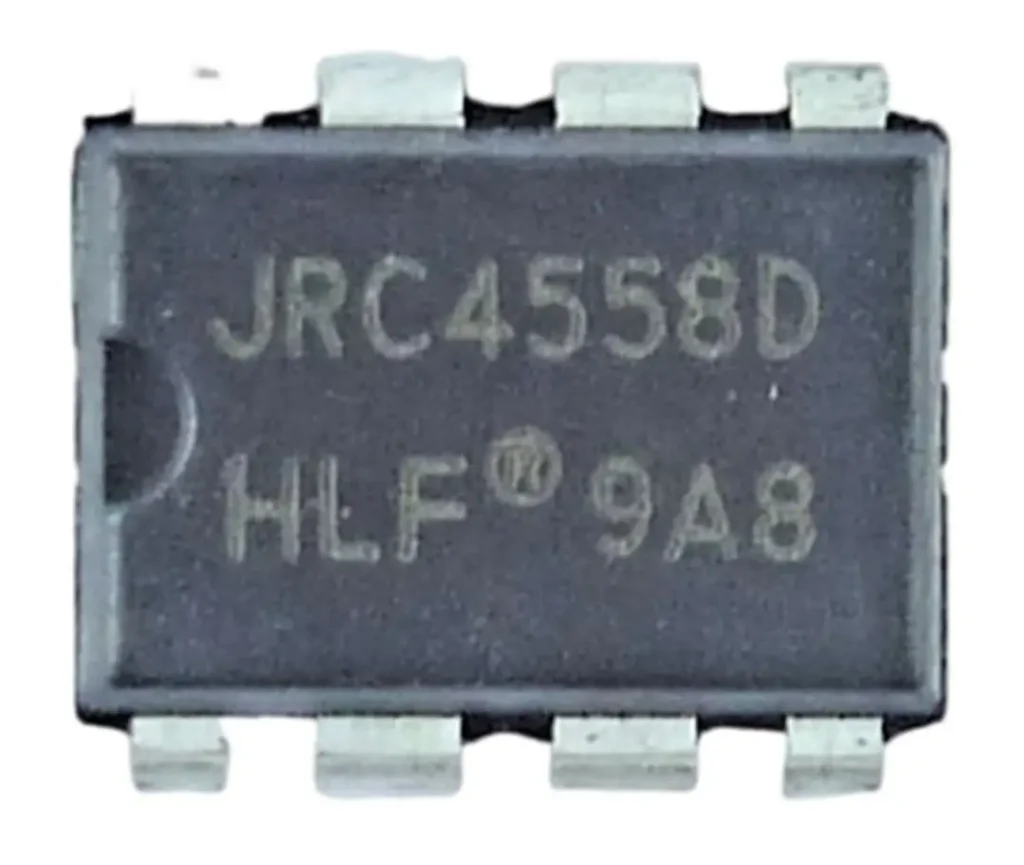
NE5532 – Industry Standard Low-Noise Dual Audio Op-Amp
The NE5532 is one of the most widely used professional audio op-amps. It is specifically designed for low-noise and low-distortion audio applications and has been a standard choice in mixers, studio equipment, and high-quality preamplifiers for decades.
Key Characteristics:
- Dual op-amp configuration
- Very low noise (~4 nV/√Hz)
- High slew rate (~9 V/µs typical)
- Wide bandwidth (~10 MHz gain-bandwidth product)
- High output drive capability (can drive 600 Ω loads)
The datasheet shows that the NE5532 is optimized for audio frequency ranges with very low distortion and excellent channel separation, making it ideal for stereo systems and professional signal chains :contentReference[oaicite:0]{index=0}.
Typical use cases:
- Audio mixers and consoles
- Hi-Fi preamplifiers
- Studio recording equipment
- Active filters and equalizers
Strength:
- Excellent noise performance
- Strong output drive
- Reliable and widely available
Limitation:
- Requires dual power supply for best performance
- Not rail-to-rail
NE5534 – High Precision Single Audio Op-Amp
The NE5534 is the single-channel version of the NE5532, designed for applications where maximum performance per channel is required. It provides better flexibility in circuit design and is often used in critical audio paths.
Key Characteristics:
- Single op-amp configuration
- Low noise (~4 nV/√Hz)
- High slew rate (~13 V/µs)
- High gain-bandwidth (~10 MHz)
- External compensation capability for stability tuning
The higher slew rate compared to dual versions allows better handling of fast signal transitions, which improves transient response in audio signals :contentReference[oaicite:1]{index=1}.
Typical use cases:
- High-end audio preamplifiers
- Microphone preamps
- Precision filter circuits
- Instrumentation-grade audio stages
Strength:
- Better control over stability (external compensation)
- High dynamic performance
Limitation:
- Requires additional components for compensation in some configurations
LM833 – Low Distortion Audio Dual Op-Amp
The LM833 is a dedicated low-noise, low-distortion audio op-amp designed as a cost-effective alternative to higher-end audio ICs. It offers strong performance for consumer and semi-professional audio systems.
Key Characteristics:
- Dual op-amp configuration
- Low noise (~4.5 nV/√Hz)
- High bandwidth (~15 MHz)
- Slew rate (~7 V/µs)
- Very low distortion (~0.002%)
According to the datasheet (page 1), the LM833 uses high-frequency PNP transistors to achieve low noise and stable frequency response, making it suitable for high-quality audio paths :contentReference[oaicite:2]{index=2}.
From the AC characteristics (page 2), it provides:
- Gain bandwidth up to 15 MHz
- Power bandwidth ~120 kHz
- Channel separation up to −120 dB
The distortion performance (shown in the graph on page 5) remains extremely low across the audio frequency range, confirming its suitability for Hi-Fi applications :contentReference[oaicite:3]{index=3}.
Typical use cases:
- Hi-Fi audio systems
- Audio preamplifiers
- Active crossover circuits
- Analog signal processing
Strength:
- Excellent cost-to-performance ratio
- Low distortion across full audio band
Limitation:
- Slightly lower slew rate than NE5534
Comparison Summary
| IC | Type | Noise | Slew Rate | Best Use |
|---|---|---|---|---|
| NE5532 | Dual | ~4 nV/√Hz | ~9 V/µs | Professional audio |
| NE5534 | Single | ~4 nV/√Hz | ~13 V/µs | High-end precision |
| LM833 | Dual | ~4.5 nV/√Hz | ~7 V/µs | Cost-effective Hi-Fi |
Conclusion of Part 2
These op-amps represent the core of professional audio design:
- NE5532: Industry standard for balanced performance
- NE5534: Precision-focused, high dynamic response
- LM833: Budget-friendly with strong audio performance
In the next part, we will explore modern audio op-amps, rail-to-rail designs, and ICs optimized for low-voltage and digital-integrated audio systems.
Audio Operational Amplifiers – JFET & Legacy Op-Amps Review (Part 3)
In this final section, we move into JFET-input audio op-amps and legacy designs that shaped modern analog circuits. These ICs focus on high input impedance, low bias currents, and improved transient response, making them suitable for high-impedance audio sources and precision analog stages.
TL072 – Low-Noise JFET Dual Op-Amp
The TL072 is a dual operational amplifier featuring a JFET input stage, which provides very high input impedance and extremely low input bias current. This makes it ideal for audio preamplifiers and circuits involving high-impedance sources.
Key Characteristics:
- Dual op-amp configuration
- JFET input stage (high input impedance)
- Low noise (~18 nV/√Hz at 1 kHz)
- High slew rate (~13 V/µs)
- Low total harmonic distortion (~0.003%)
The datasheet highlights that the TL072 combines JFET inputs with bipolar output stages, resulting in a balance between high input impedance and good output drive capability :contentReference[oaicite:0]{index=0}.
Typical use cases:
- Audio preamplifiers
- Guitar input stages
- Active filters
- Signal buffering
Strength:
- Very high input impedance
- Low distortion and good audio quality
Limitation:
- Higher noise than NE5532
- Requires dual supply for optimal performance
TL074 – Quad JFET Audio Op-Amp
The TL074 is a quad version of the TL072, integrating four JFET-input op-amps in a single package. It is widely used in multi-stage audio processing systems and analog signal chains.
Key Characteristics:
- Four op-amps in one IC
- JFET input structure
- Low noise and low distortion
- High slew rate (~13 V/µs)
As shown in the datasheet, the TL074 maintains similar electrical characteristics to the TL072, including high input impedance (~1012 Ω) and wide bandwidth (~3 MHz) :contentReference[oaicite:1]{index=1}.
Typical use cases:
- Audio distribution amplifiers
- Multi-band equalizers
- Signal routing and mixing systems
Strength:
- High channel density
- Consistent performance across all channels
TL082 – Improved JFET General-Purpose Op-Amp
The TL082 is closely related to the TL072 but designed for more general-purpose applications while maintaining JFET input advantages. It offers a balance between performance and cost.
Key Characteristics:
- Dual op-amp configuration
- JFET input stage
- High input impedance
- Moderate noise performance
It shares similar internal architecture and behavior with the TL07x series, making it interchangeable in many analog and audio circuits.
Typical use cases:
- General-purpose audio circuits
- Signal conditioning
- Analog control systems
UA741 – Legacy General-Purpose Op-Amp
The UA741 is one of the earliest and most iconic operational amplifiers. While not designed specifically for audio, it played a major role in the development of analog electronics.
Key Characteristics:
- Single op-amp configuration
- Internal frequency compensation
- High gain (~200 V/mV)
- Wide supply voltage range (up to ±22 V)
The datasheet describes it as a general-purpose amplifier suitable for integrators, summing amplifiers, and active filters :contentReference[oaicite:2]{index=2}.
From the electrical characteristics:
- Slew rate ~0.5 V/µs
- Gain bandwidth ~1 MHz
- Higher noise (~23 nV/√Hz)
Typical use cases:
- Educational circuits
- Basic analog designs
- Legacy equipment
Limitation:
- Very low slew rate
- High noise compared to modern op-amps
- Not suitable for high-fidelity audio
Comparison Summary
| IC | Type | Input Type | Slew Rate | Audio Suitability |
|---|---|---|---|---|
| TL072 | Dual | JFET | ~13 V/µs | Good (Hi-Z inputs) |
| TL074 | Quad | JFET | ~13 V/µs | Multi-stage audio |
| TL082 | Dual | JFET | ~13 V/µs | General-purpose audio |
| UA741 | Single | Bipolar | ~0.5 V/µs | Not suitable (modern audio) |
Final Conclusion
Across all three parts, we can classify audio op-amps into three generations:
- Basic / Legacy: UA741 – foundational but outdated
- General-Purpose Audio: 4558, LM358, LM324 – widely used but limited performance
- Professional Audio: NE5532, NE5534, LM833, TL072 – optimized for low noise and high fidelity
Modern audio design typically favors low-noise, high-slew-rate op-amps with better distortion characteristics, but older ICs are still widely used due to availability, cost, and design familiarity.
FAQ
Which op-amp is best for audio applications?
For most audio applications, NE5532 and NE5534 are preferred due to their very low noise, high bandwidth, and good slew rate. TL072 is also widely used where high input impedance is required.
Is TL072 better than NE5532 for audio?
It depends on the application. TL072 offers very high input impedance due to its JFET inputs, making it ideal for guitar and high-impedance sources. NE5532 provides lower noise and better overall fidelity for professional audio circuits.
Why is the 4558 still used in audio circuits?
The 4558 is widely available, stable, and has a characteristic analog response that is preferred in some designs such as guitar pedals and analog mixers.
Can LM358 be used for audio applications?
LM358 can be used for basic audio circuits, but it is not suitable for high-fidelity audio due to its low slew rate and limited bandwidth.
Is UA741 suitable for modern audio circuits?
No, UA741 is outdated for audio use. It has higher noise, low slew rate, and limited bandwidth compared to modern audio op-amps.
What is the importance of slew rate in audio op-amps?
Slew rate determines how quickly an op-amp can respond to rapid signal changes. Higher slew rate improves transient response and reduces distortion in audio signals.
What is the difference between JFET and bipolar input op-amps?
JFET input op-amps provide very high input impedance and low bias current, while bipolar op-amps typically offer lower noise and stronger output drive capability.