Minimum order value ₹99.00 · Get 10% Off on Cart Value use Coupon code VASP10 · Free shipping over ₹999.00


Integrated Circuit Audio Amplifiers Review – Design, Uses and Limitations

Integrated circuit (IC) audio power amplifiers dominate real-world audio electronics not because they offer extreme performance, but because they provide a balanced and predictable solution. They sit between discrete simplicity and high-performance specialization, delivering usable power, compact size, and repeatable behavior with minimal design overhead.
From desktop speakers to home audio systems and mono subwoofer amplifiers, IC amplifiers are used wherever reliability, cost control, and practical buildability are required.
Scope of This Review
This review explains integrated circuit audio power amplifiers from a practical, system-level perspective. It focuses on how they are constructed, why they are widely used, and where their real-world limitations appear during implementation.
- Definition and internal structure of IC amplifiers
- Reasons for widespread adoption
- Behavior in real amplifier builds
- Thermal, layout, and customization limits
- Appropriate application scenarios
Definition of an Integrated Circuit Amplifier
An integrated circuit audio amplifier is a power amplifier in which most of the signal-processing and output stages are implemented within a single semiconductor package.
A typical audio amplifier IC integrates:
- Input differential amplification stage
- Voltage gain stage
- Output driver and power devices
- Biasing and compensation networks
- Thermal and short-circuit protection
Only a limited number of external components are required to set gain, frequency response, and stability. In practice, an IC amplifier functions as a complete amplifier system rather than a single active device.
Reasons IC Amplifiers Became the Default Choice
Reduced Component Count and Cost
By integrating many internal components onto one chip, IC amplifiers significantly reduce external part count. This lowers PCB complexity, assembly effort, and overall system cost compared to discrete amplifier designs.
Compact PCB Footprint
IC amplifiers occupy very little board space relative to the output power they deliver. Output stages that would otherwise require multiple discrete transistors and driver circuitry are contained within a single package.
Simplified Fault Diagnosis
Troubleshooting IC amplifier systems is generally straightforward. Most faults originate in the power supply, external passive components, or the IC itself.
Ease of Replacement
When failure occurs, IC amplifiers can usually be replaced without recalibration. There is no need for transistor matching or bias adjustment after replacement.
Built-In Protection Mechanisms
Most IC amplifiers include internal thermal shutdown and short-circuit protection. These features reduce the risk of catastrophic failure during abnormal operating conditions.
Predictable Datasheet-Governed Behavior
When supply voltage limits, load impedance requirements, decoupling guidelines, and layout recommendations are followed, IC amplifiers behave in a predictable and repeatable manner.
“Jack of All Trades” in Practical Use
Integrated circuit amplifiers are used across a wide range of audio applications:
- Low-power desktop and portable audio
- Stereo home amplifier systems
- 2.1 channel audio systems
- Multi-channel automotive audio
- High-power mono and subwoofer amplifiers
They are rarely optimized for extreme performance in any single category, but their ability to perform adequately across many applications defines their value.
Behavior Across Power Levels
Low to Medium Power Stereo Applications
In low and medium power designs, IC amplifiers clearly demonstrate the effects of grounding, power supply quality, and PCB layout on audible performance.
High-Fidelity Audio Applications
Certain IC amplifiers are widely used in hi-fi systems. With appropriate power supply design and thermal management, they provide clean audio at realistic listening levels.
High-Power Mono Operation
High-power IC amplifiers are commonly used in mono and subwoofer configurations. At these power levels, heatsinking and power supply capability dominate overall system performance.
Multi-Channel Integration
Multi-channel IC amplifiers integrate multiple independent amplifier channels into a single package, enabling compact automotive and multi-speaker designs.
2.1 Channel Integrated Solutions
Some IC amplifiers integrate stereo channels with a dedicated low-frequency channel, simplifying 2.1 system implementation and reducing external circuitry.
Practical Limitations of IC Amplifiers
High Thermal Density
All output devices are concentrated in a small silicon area. Without sufficient heatsinking and airflow, thermal limits restrict continuous output power.
PCB Layout Sensitivity
Despite internal integration, IC amplifiers remain sensitive to PCB layout. Poor grounding, long supply traces, or inadequate decoupling can cause oscillation and instability.
Limited Internal Customization
Internal amplifier stages cannot be modified. Unlike discrete designs, internal topology, compensation, and bias structures are fixed.
Educational and System-Level Value
IC amplifiers expose real-world design constraints such as supply impedance, grounding noise, and thermal behavior clearly. This makes them effective platforms for learning system-level audio design.
Appropriate Use Cases
- When predictable performance is required
- When space and cost are constrained
- When reliability is prioritized over customization
- When a practical, buildable system is the goal
Common Implementation Errors
- Underestimating heatsink requirements
- Neglecting power supply quality
- Ignoring datasheet layout recommendations
- Assuming peak power ratings are continuous
Summary
Integrated circuit audio power amplifiers succeed by respecting real-world constraints. They are not optimized for extremes, but they provide a reliable balance of performance, size, and simplicity.
Their continued use across consumer, automotive, and professional audio systems reflects their effectiveness as practical engineering solutions.
Products Offered by VASP Electronics
The following integrated circuit audio amplifier boards and kits are offered by VASP Electronics. These products are commonly used for stereo, mono, multi-channel, and 2.1 channel audio amplifier builds.
- TDA7294 100 Watt Audio Power Amplifier Board (PCB Only)
- LM3886 High Performance Audio Amplifier PCB (PCB Only)
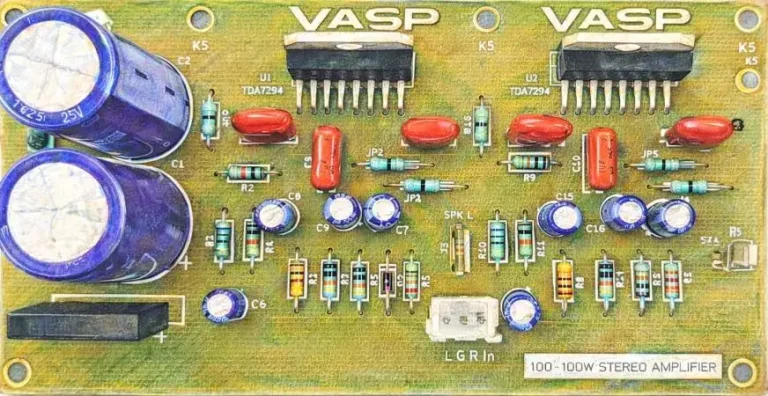
- TDA7294 100+100 Watt Stereo Amplifier Board (PCB Only)
- TDA2030 / TDA2050 / LM1875 Stereo Amplifier Board (PCB Only)
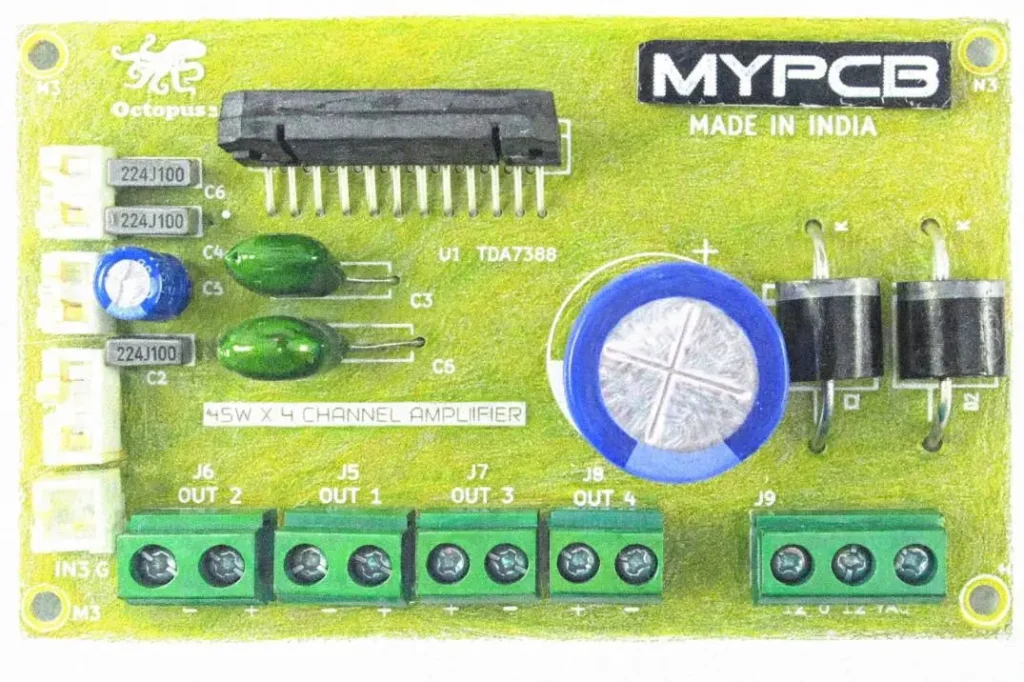
- TDA7388 45W × 4 Channel Audio Power Amplifier Board
- TDA2030 20+20 Watt Stereo Amplifier Board (Hobby Kit)
- TDA7388 / TDA7389 45W × 4 Channel Amplifier PCB (PCB Only)
- TDA7265 2.1 Amplifier Board for Home Theater Systems
- TDA7265 / TDA7292 2.1 Amplifier Board (PCB Only)
- TDA7294 100+100 Watt Stereo Power Amplifier Board
- TDA7294 100 Watt High Power Audio Amplifier Board
- LM3886 High Performance Audio Amplifier Board
Frequently Asked Questions
Are IC audio amplifiers suitable for high-fidelity audio?
Yes. Many integrated circuit amplifiers provide very good audio performance when used with a proper power supply, correct PCB layout, and adequate heatsinking. Several well-known amplifier ICs are widely used in hi-fi audio systems.
Why do IC amplifiers require heatsinks?
IC audio amplifiers dissipate power inside a small silicon chip. When output power increases, the device generates heat that must be removed through a heatsink to prevent thermal shutdown or device failure.
Are discrete amplifiers better than IC amplifiers?
Discrete amplifiers allow more customization and can achieve very high performance, but they require more design effort and components. IC amplifiers provide predictable performance with much simpler implementation.
Can IC amplifiers be used for subwoofer amplifiers?
Yes. Many high-power audio amplifier ICs are commonly used in mono subwoofer amplifiers and home audio systems. Proper power supply capability and cooling are essential for stable operation.
What causes IC audio amplifiers to oscillate?
Oscillation can occur when PCB layout, grounding, decoupling capacitors, or load conditions do not follow the amplifier IC’s datasheet recommendations. Proper layout and power supply filtering are important for stable operation.