Minimum order value ₹99.00 · Get 10% Off on Cart Value use Coupon code VASP10 · Free shipping over ₹999.00


Discrete Amplifier Boards Comparison and Review

Discrete Mono Amplifier Boards – Practical Comparison
This review compares six discrete-component mono amplifier boards from VaspElectronics, covering power levels from 100W to 600W. All boards use dual-rail power supplies and are intended for DIY audio builds, speaker systems, and subwoofer applications.
1. 100W Mono Amplifier Board (C5200 / A1943)
Product Link:
View Product
Position: Entry-level discrete amplifier
- Output: up to 100W
- Supply: ±18V to ±35V DC
- Transformer: 24-0-24 VAC
- Fully assembled
- Compact PCB (2.8″ × 3.5″)
Pros:
- Compact and easy to integrate
- Good for small home audio builds
- Fully assembled and tested
- Uses proven C5200/A1943 pair
Cons:
- Limited headroom for larger speakers
- Still requires dual power supply
- Not ideal for high SPL setups
2. 100W MOSFET Amplifier Board
Product Link:
View Product
Position: Cleaner 100W option (MOSFET-based)
- Output: up to 100W
- THD: ~0.07% at 70W
- Supply: ±18V to ±35V DC
- Fully assembled
Pros:
- MOSFET output stage (smoother response)
- Specified distortion performance
- Good for full-range audio
Cons:
- Similar power to transistor version
- Requires proper heat sinking
- No protection features mentioned
3. 150W Amplifier Board (2SC5200)
Product Link:
View Product
Position: Mid-range upgrade from 100W class
- Output: up to 150W
- THD: ~0.01% at 60W
- Supply: ±18V to ±35V DC
- Flexible transformer range
Pros:
- Better power headroom than 100W boards
- Lower distortion figure
- Good balance of power and control
Cons:
- Still requires careful thermal management
- No onboard protection mentioned
4. 200W Amplifier Board (C5200 / A1943)
Product Link:
View Product
Position: Standard high-power DIY amplifier
- Output: up to 200W
- Supply: ±18V to ±45V DC
- Transformer: 30-0-30 VAC (3A–5A)
Pros:
- Strong output for most home systems
- Handles subwoofer and full-range use
- Proven transistor design
Cons:
- Power depends on supply and cooling
- No protection circuitry specified
5. 400W Amplifier Board (C5200 / A1943)
Product Link:
View Product
Position: High-power discrete amplifier
- Output: up to 400W
- Supply: ±18V to ±45V DC
- Transformer: 30-0-30 VAC (5A–8A)
- Fully assembled
Pros:
- High output capability
- Suitable for large speakers and subwoofers
- Repairable discrete design
Cons:
- Requires large heatsink and strong PSU
- Not beginner-friendly
- Real output depends on setup
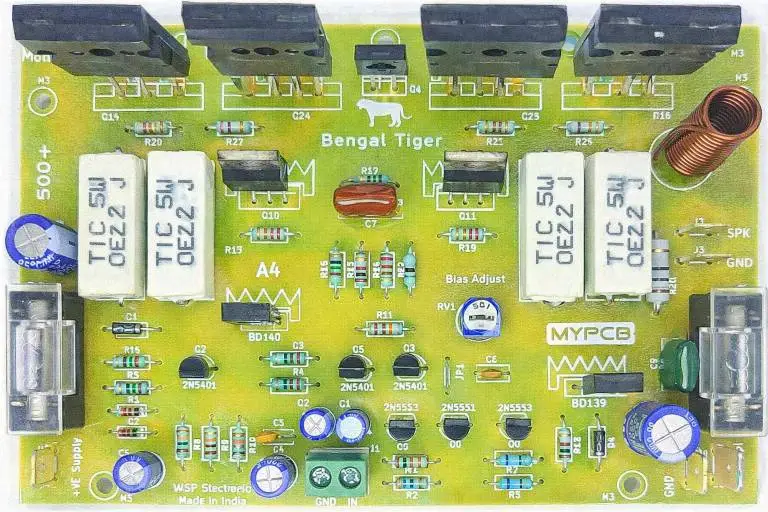
6. 600W MOSFET Amplifier Board
Product Link:
View Product
Position: Maximum power / professional-grade board
- Output: up to 600W
- THD+N: ~0.1% at 400W
- Supply: ±24V to ±55V DC
- Transformer: 35-0-35 VAC (5A–10A)
- Includes protection (fuses + short-circuit)
Pros:
- Highest power in this group
- Includes basic protection features
- MOSFET design for high-current handling
- Suitable for PA and DJ setups
Cons:
- Requires heavy-duty power supply
- Large heatsink mandatory
- Overkill for small home setups
Comparison Summary
| Board | Power Class | Best Use |
|---|---|---|
| 100W (BJT) | Low | Compact home audio |
| 100W (MOSFET) | Low | Cleaner audio builds |
| 150W | Mid | Balanced systems |
| 200W | Mid-High | Subwoofer + full-range |
| 400W | High | Large speakers |
| 600W MOSFET | Very High | PA / DJ systems |
Final Conclusion
All boards follow a similar discrete design philosophy, but they serve very different use cases.
- Choose 100W boards for compact and beginner-friendly builds
- Choose 150W–200W for balanced performance in home audio systems
- Choose 400W if you need serious output for subwoofers
- Choose 600W MOSFET only if you are building high-power PA or DJ systems
The main deciding factor is not just power rating, but your ability to provide:
- Proper dual-rail power supply
- Adequate heat sinking
- Correct speaker matching
Without these, even the highest-rated board will not perform as expected.
Frequently Asked Questions (FAQ)
1. Which amplifier board is best for home audio?
For typical home audio setups, 100W to 150W boards are sufficient. They provide good sound output without requiring very large power supplies or heat sinks.
2. Which board is suitable for subwoofer applications?
200W and 400W boards are better suited for subwoofers. They provide higher power output required for low-frequency reproduction.
3. Is the 600W amplifier board suitable for beginners?
No. The 600W board requires a high-current power supply, large heat sinks, and proper system design. It is better suited for experienced users.
4. What is the difference between MOSFET and transistor (BJT) amplifier boards?
MOSFET boards typically offer smoother sound characteristics and better thermal stability, while BJT-based boards are simpler, widely available, and easier to repair.
5. Do these boards include protection circuits?
Only the 600W MOSFET board explicitly includes protection features such as fuses and short-circuit protection. Other boards require external protection if needed.
6. What power supply is required for these amplifier boards?
All boards require a dual-rail DC power supply. This is usually created using a step-down transformer (e.g., 24-0-24 VAC or 30-0-30 VAC), rectifier, and filter capacitors.
7. Can I use 4Ω and 8Ω speakers with these boards?
Yes. All listed boards support both 4Ω and 8Ω speaker loads, but output power and heat dissipation will vary based on the load.
8. Why is heatsinking important?
These are high-power amplifier boards. Without proper heat sinks, the output transistors or MOSFETs can overheat and fail during continuous operation.