Minimum order value ₹99.00 · Get 10% Off on Cart Value use Coupon code VASP10 · Free shipping over ₹999.00

Discrete Audio Power Amplifier Boards – Features, Operation and Applications

Discrete audio power amplifier boards are widely used in DIY audio systems, speaker amplifiers, and custom sound equipment. Unlike integrated amplifier IC modules, these boards use individual transistors, resistors, and other components to build the amplifier stage.
Because every part of the circuit is visible and accessible, discrete amplifiers provide high flexibility, higher output power potential, and easier servicing. Many hobbyists and technicians prefer these amplifier boards when building custom hi-fi systems, subwoofer amplifiers, or high-power audio setups.
This guide explains how discrete amplifier boards work, what advantages they provide compared with IC amplifier modules, and where they are commonly used in real audio systems.
What Is a Discrete Audio Power Amplifier?
A discrete amplifier is an audio amplifier built using individual semiconductor devices such as transistors or power MOSFETs rather than a single integrated circuit.
Instead of relying on a chip to perform all amplification tasks, the circuit is divided into multiple stages that control signal amplification and power delivery to the speaker.
- Input and small-signal stages for signal conditioning
- Voltage amplification stage for increasing signal swing
- Output stage responsible for delivering current to the loudspeaker
This multi-stage design allows the amplifier to deliver higher current and power while maintaining stability under varying load conditions.
How Discrete Amplifier Boards Deliver Power
In audio systems, the input signal from a phone, mixer, or preamplifier contains very little energy. The amplifier uses this small signal to control a much larger amount of energy stored in the power supply.
The output stage transistors act like a controlled valve between the positive and negative power rails. Small voltage changes at the input result in larger current changes at the output, allowing the amplifier to drive loudspeakers with significant power.
Because speakers are dynamic loads with changing impedance, the amplifier must remain stable while delivering current under constantly changing conditions.
Advantages of Discrete Amplifier Boards
Higher Output Power Capability
Discrete amplifier circuits can scale easily to higher power levels. Designers can increase the number of output devices, improve heatsinking, and use stronger power supplies to increase power capability.
Better Thermal Management
Most discrete amplifier boards allow large external heatsinks to be attached to the output devices. This improves heat dissipation and allows the amplifier to operate reliably at higher power levels.
Serviceable Design
Because individual components are used, failed parts can be replaced easily. This makes discrete amplifiers suitable for repairable and long-life audio equipment.
Flexible Circuit Design
Discrete designs allow adjustment of bias current, operating class, and component selection. This flexibility makes them popular among audio hobbyists and amplifier builders.
Real-World Operating Conditions
In real audio systems, amplifiers do not operate under ideal conditions. Loudspeakers present complex loads whose impedance varies with frequency and cone movement.
During loud music passages, current demand can rise rapidly. The amplifier must deliver this current while maintaining stability and avoiding overheating or distortion.
For this reason, power supply quality, cooling, and proper wiring play an important role in amplifier reliability.
Thermal and Power Supply Considerations
Heat Dissipation
Linear audio amplifiers dissipate a significant portion of power as heat. Any energy that is not delivered to the speaker must be removed through heatsinking.
Adequate cooling is essential for preventing thermal runaway and maintaining long-term stability of the output devices.
Power Supply Stability
High-power audio amplifiers draw large current pulses from the power supply. If the supply voltage drops excessively during these peaks, distortion or compression can occur.
A stable transformer-based power supply with sufficient filtering capacitors is typically recommended for discrete amplifier systems.
Applications of Discrete Amplifier Boards
Discrete amplifier boards are commonly used in many audio projects and commercial equipment where higher output power and flexibility are required.
- DIY hi-fi audio amplifiers
- Subwoofer amplifier systems
- Home theater speaker amplifiers
- High-power mono amplifier builds
- Audio experimentation and educational projects
Basic Tools Required for Amplifier Builds
- Digital multimeter for measuring voltage and bias
- Oscilloscope for checking waveform clipping and noise
- Stable transformer power supply
- Large heatsinks with proper thermal compound
- Basic electronic components for testing and adjustment
Careful measurement and gradual testing help prevent damage during amplifier assembly and initial power-up.
Practical Tips When Building Amplifiers
- Always test the amplifier at lower supply voltage first
- Monitor output transistor temperature during testing
- Check DC offset before connecting speakers
- Use short wiring paths for signal connections
- Ensure good grounding to avoid noise or oscillation
Discrete Audio Amplifier Boards Available
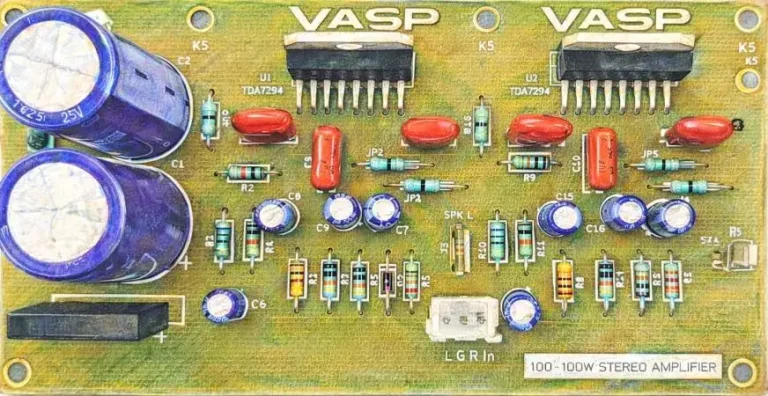
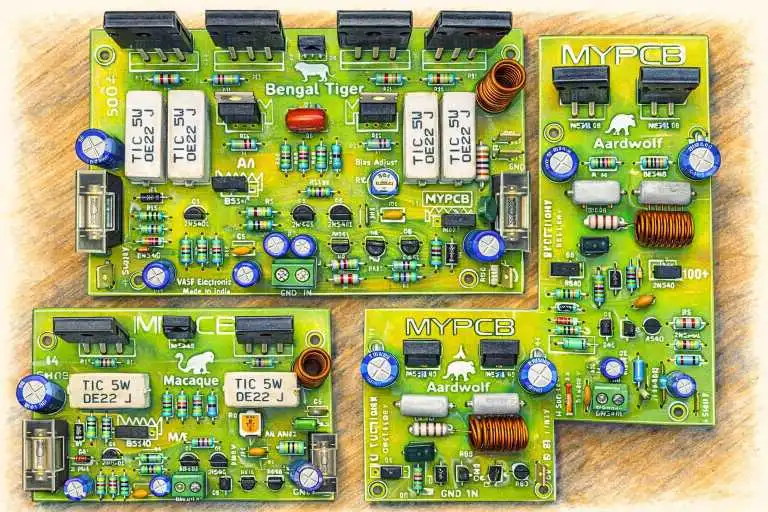
Vasp Electronics offers several discrete amplifier boards suitable for DIY audio builds and speaker amplifier systems. These boards range from moderate-power designs for home audio to high-power MOSFET amplifier boards used in larger sound systems.
- 100W Audio Power Amplifier Board
- 100W MOSFET Audio Power Amplifier Board
- 150W Hi-Fi Audio Power Amplifier Board
- 200W Hi-Fi Audio Power Amplifier Board
- 400W Hi-Fi Audio Power Amplifier Board
- 600W MOSFET Audio Power Amplifier Board
- 100+100W Stereo Audio Power Amplifier Board
Frequently Asked Questions
What is a discrete audio power amplifier board?
A discrete audio power amplifier board is an amplifier circuit built using individual components such as transistors, resistors, and capacitors instead of a single integrated amplifier IC. These boards are commonly used in DIY audio systems and high-power amplifier projects.
What are the advantages of discrete amplifier boards?
Discrete amplifier boards allow higher power scalability, better thermal management using external heatsinks, and easier servicing because individual components can be replaced if a failure occurs.
Do discrete amplifier boards require large heatsinks?
Yes. Linear audio amplifiers dissipate significant heat during operation. Proper heatsinking is necessary to maintain safe operating temperatures and ensure reliable performance of the output transistors or MOSFETs.
What power supply is typically used with discrete amplifier boards?
Most discrete audio amplifier boards use a transformer-based power supply with rectifier and filter capacitors. The supply must provide stable voltage and sufficient current to support the amplifier’s output power.
Are discrete amplifier boards suitable for beginners?
Yes. Many DIY electronics hobbyists start with moderate-power amplifier boards. Careful testing, proper heatsinking, and correct wiring practices help beginners safely build and operate these amplifiers.