Minimum order value ₹99.00 · Get 10% Off on Cart Value use Coupon code VASP10 · Free shipping over ₹999.00

Bridge Rectifier Review and Comparison Guide

Bridge rectifiers are widely used in power supplies, battery chargers, audio amplifiers, solar controllers, and many other electronic circuits that require conversion of AC voltage into DC. A bridge rectifier contains four diodes arranged in a bridge configuration that converts both halves of the AC waveform into a pulsating DC output.
This review examines several commonly used bridge rectifier families ranging from small low-current PCB rectifiers to high-power metal case rectifiers used in large power supplies. The devices reviewed here represent different current classes while sharing the same maximum voltage rating of 1000 V.
- Low current PCB bridge rectifiers
- Medium power bridge rectifiers used in electronic circuits
- High current bridge rectifiers used in power supplies and amplifiers
Bridge Rectifier Basics
A bridge rectifier consists of four diodes connected in a bridge configuration. During each half cycle of the AC input, two diodes conduct and direct current to the output with the same polarity. This allows the circuit to convert both halves of the AC waveform into usable DC.
Bridge rectifiers are typically used together with filter capacitors to produce a smoother DC voltage.
Important parameters when selecting a bridge rectifier include:
Maximum Reverse Voltage (VRRM)
The highest reverse voltage the rectifier can safely block.
Average Forward Current (IF(AV))
The maximum continuous current the rectifier can supply.
Forward Voltage Drop (VF)
The voltage lost across the conducting diode.
Peak Forward Surge Current (IFSM)
The maximum surge current the rectifier can tolerate during startup.
Thermal Resistance
Determines how effectively the rectifier can dissipate heat.
Bridge Rectifier Comparison Table
| Device | Voltage | Current | Surge Current | Package | Typical Applications |
|---|---|---|---|---|---|
| W10M | 1000 V | 1.5 A | 50 A | WOM | Small power supplies |
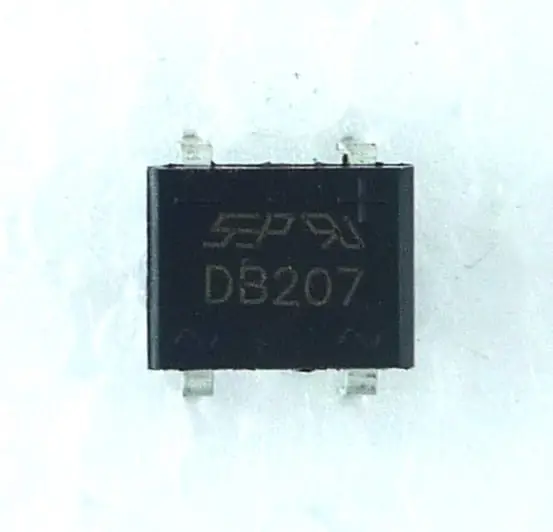
| DB207 | 1000 V | 2 A | 60 A | DB | Low-power electronics |
| KBL10 | 1000 V | 4 A | 200 A | KBL | Consumer electronics power supplies |
| BR1010 | 1000 V | 10 A | 200 A | BR | Medium power supplies |
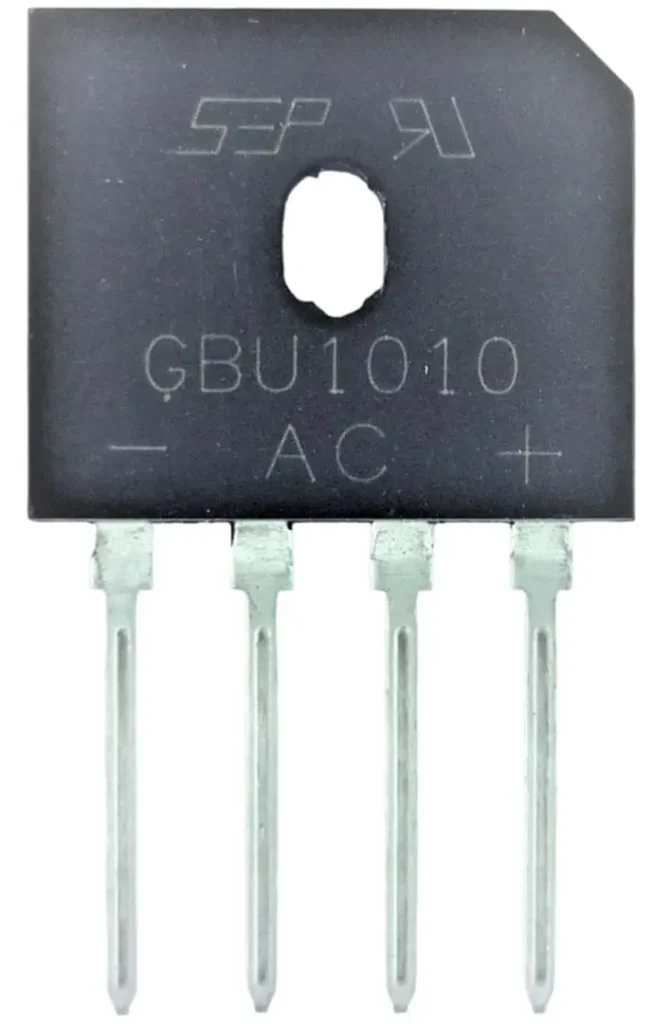
| GBU1010 | 1000 V | 10 A | 220 A | GBU | General purpose rectification |
| GBJ1510 | 1000 V | 15 A | 240 A | GBJ | Power supplies and chargers |
| D25XB100 | 1000 V | 25 A | 300 A | D25XB | Large linear power supplies |
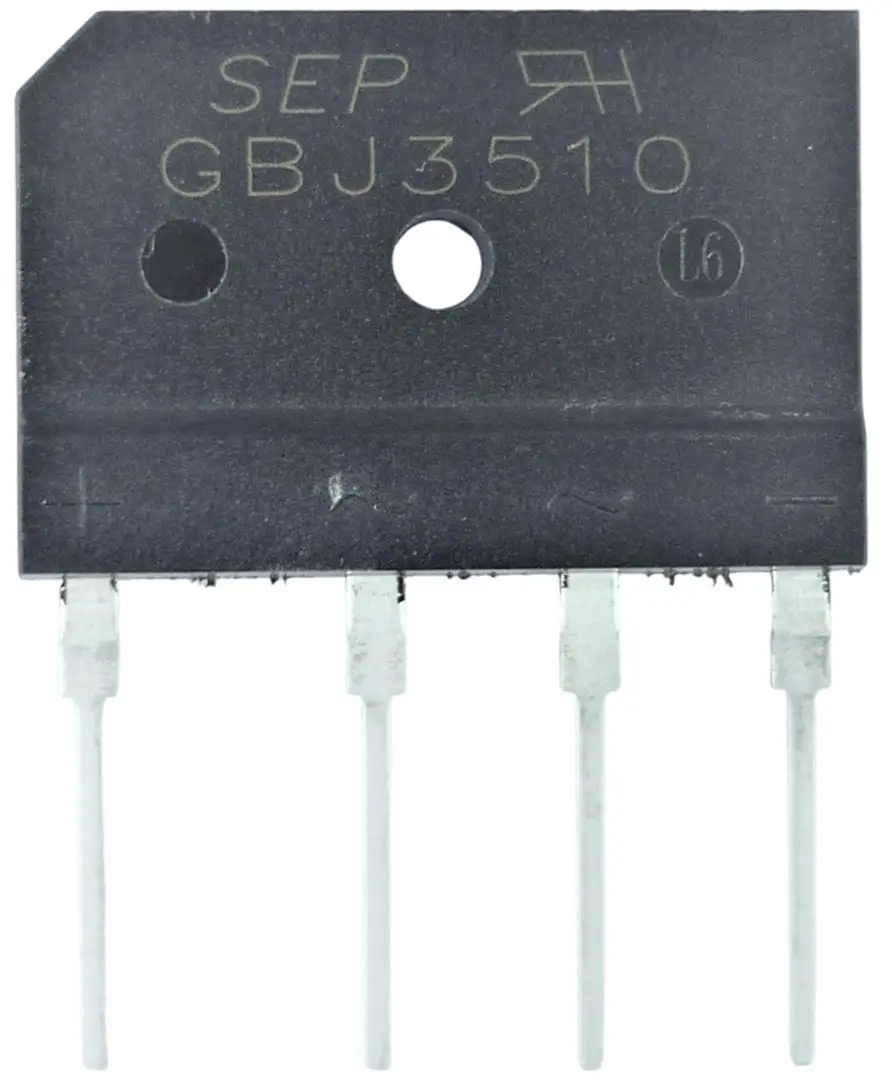
| GBJ3510 | 1000 V | 35 A | 320 A | GBJ | High power rectification |
| KBPC5010 | 1000 V | 50 A | 400 A | KBPC | Industrial power supplies |
Low-Current Bridge Rectifiers
Devices such as W10M and DB207 are designed for small power supplies and electronic circuits that require relatively low current. These compact packages are commonly used in:
- Wall adapters
- Control circuits
- Small chargers
- Instrumentation power supplies
Their small size allows them to be mounted directly on printed circuit boards without the need for heatsinks.
Medium-Power Bridge Rectifiers
Rectifiers such as KBL10, BR1010, and GBU1010 are commonly used in general electronic equipment where moderate current is required.
Typical applications include:
- Audio amplifier power supplies
- DC motor drivers
- LED power supplies
- Battery chargers
These rectifiers often include mounting holes or larger cases to improve heat dissipation when operating at higher current levels.
High-Current Bridge Rectifiers
High-power rectifiers such as D25XB100, GBJ3510, and KBPC5010 are designed for heavy current applications where large amounts of power must be converted.
Typical uses include:
- Large linear power supplies
- Industrial power equipment
- High-power battery chargers
- Welding power supplies
- Audio amplifier power stages
These rectifiers usually require mounting to a heatsink or metal chassis to dissipate heat effectively.
Package Types
Bridge rectifiers are manufactured in a variety of package styles:
- WOM / W10M – compact round PCB package
- DB package – small inline bridge rectifier
- KBL package – medium power PCB rectifier
- GBU / GBJ packages – high current molded rectifiers
- D25XB package – heavy duty PCB mounted rectifier
- KBPC package – metal case bolt-mounted rectifier
Larger packages allow better heat dissipation and support higher current ratings.
Choosing the Right Bridge Rectifier
Selecting a bridge rectifier requires careful consideration of voltage rating, current capacity, and thermal management.
- Choose a voltage rating at least 2–3 times the AC input voltage
- Select a current rating higher than the expected load current
- Ensure adequate heat dissipation using PCB copper area or heatsinks
- Consider surge current capability for circuits with large filter capacitors
Proper rectifier selection improves reliability and ensures safe operation of the power supply.
Conclusion
Bridge rectifiers are essential components in power electronics and AC-to-DC conversion circuits. From small PCB rectifiers like the W10M to high-power devices such as the KBPC5010, these components enable efficient power conversion across a wide range of applications.
Understanding current ratings, surge capability, and thermal characteristics helps designers select the correct bridge rectifier for their power supply or electronic system.
FAQ
What is a bridge rectifier used for?
A bridge rectifier is used to convert alternating current (AC) into direct current (DC). It is commonly used in power supplies, battery chargers, audio amplifiers, LED drivers, and many electronic devices that require DC voltage.
How does a bridge rectifier work?
A bridge rectifier uses four diodes arranged in a bridge configuration. During each half cycle of the AC input, two diodes conduct and direct current to the output with the same polarity, producing full-wave rectified DC.
What voltage rating should a bridge rectifier have?
The bridge rectifier voltage rating should normally be at least two to three times higher than the peak AC voltage of the transformer secondary. This provides a safety margin and protects the rectifier from voltage spikes.
Why do bridge rectifiers have high surge current ratings?
Bridge rectifiers must handle large surge currents when the power supply first turns on and the filter capacitors charge. The surge current rating ensures the rectifier can survive these short high-current pulses.
Do bridge rectifiers require heatsinks?
Low-current bridge rectifiers used in small circuits usually do not require heatsinks. However, high-current rectifiers such as GBJ, D25XB, or KBPC types often require mounting to a heatsink or metal chassis to dissipate heat.
What is the difference between small PCB bridge rectifiers and metal case rectifiers?
Small PCB bridge rectifiers like W10M or DB207 are designed for low current circuits and can be mounted directly on the PCB. Metal case rectifiers such as KBPC5010 are designed for high current applications and are mounted to a chassis or heatsink for better thermal performance.