Minimum order value ₹99.00 · Get 10% Off on Cart Value use Coupon code VASP10 · Free shipping over ₹999.00

Audio Power Amplifier IC Review & Comparison – Hi-Fi, Portable and Automotive Designs

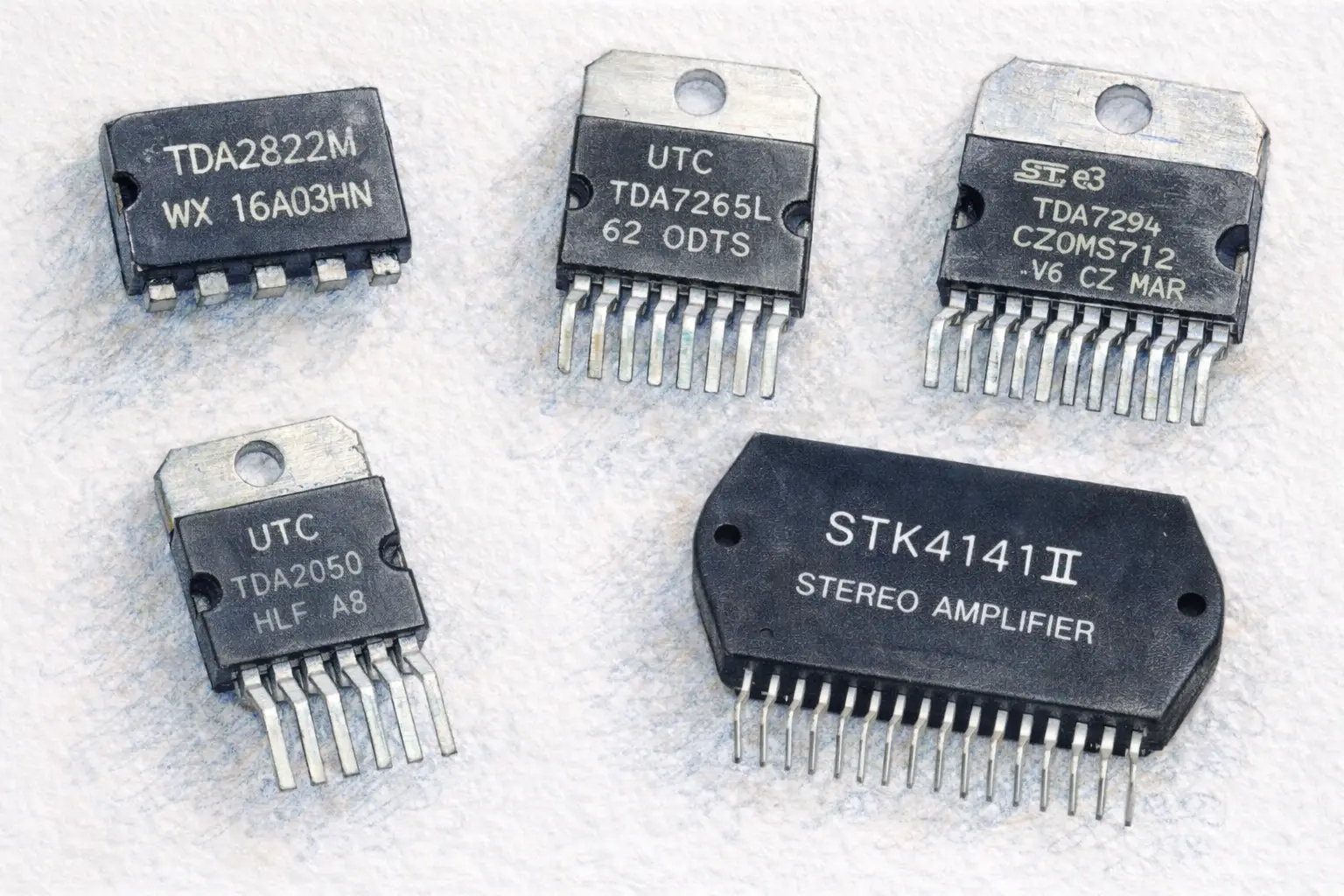
This review evaluates widely used audio power amplifier ICs across low-voltage portable systems, home Hi-Fi split-supply designs, and automotive 12V multi-channel applications. Instead of listing specifications alone, each IC is analyzed based on real-world usability, distortion behavior, thermal demands, protection features, and practical design strengths and weaknesses. The goal is to help builders and designers choose the right amplifier IC for their specific power, supply, and performance requirements.
Low-Voltage & Portable Audio Power Amplifier ICs – Detailed Review
This section reviews low-voltage and portable audio power amplifier ICs designed for compact systems, battery-operated devices, 12V automotive applications, and small active speaker systems. These ICs prioritize simple power supply requirements, minimal external components, and integrated protection features.
- TDA2822D
- TDA1010A
- LA4440
- TDA7297
TDA2822D – Ultra Low Voltage Dual Amplifier
The TDA2822D is a dual low-voltage audio amplifier intended for portable equipment such as radios, cassette players, small multimedia speakers, and low-power DIY projects. It supports both stereo and bridge configurations.
Electrical Profile
- Supply Range: 1.8V – 15V
- Stereo Output: up to 380mW @ 6V, 8Ω
- Bridge Output: up to ~1W @ 9V
- THD: ~0.2%
- Quiescent Current: ~15mA
Design Observations
Its ability to operate from very low supply voltages makes it ideal for battery-driven systems. However, due to its limited power handling and high thermal resistance, it is unsuitable for high-output speaker systems.
Pros
- Operates down to 1.8V
- Very low quiescent current
- Supports bridge configuration
- No heatsink required in most applications
- Simple external circuitry
Cons
- Very limited output power
- Not suitable for 4Ω high-volume use
- Moderate distortion at higher output
- Not designed for Hi-Fi applications
TDA1010A – Classic 12V Mono Car Amplifier
The TDA1010A is a mono amplifier designed for automotive applications. It operates directly from 12V systems and supports low impedance loads.
Electrical Profile
- Supply Range: 6V – 24V
- Output: ~6W @ 14.4V (4Ω)
- THD: ~0.2% @ 1W
- Efficiency: ~75%
- Peak Output Current: up to 5A
Design Observations
This IC predates modern BTL automotive designs. It often requires output coupling capacitors and is better suited for rugged, basic systems rather than high-fidelity builds.
Pros
- Wide supply tolerance
- Strong current capability
- Thermal protection included
- Proven automotive reliability
Cons
- Lower output compared to modern BTL ICs
- Requires larger external components
- Not ideal for stereo systems without duplication
- Older architecture
LA4440 – Popular 12V Stereo / Bridge Amplifier
The LA4440 is one of the most widely used low-cost 12V amplifier ICs. It supports stereo 6W + 6W operation or bridge mode up to approximately 19W.
Electrical Profile
- Nominal Supply: 13.2V
- Stereo Output: 6W × 2
- Bridge Output: ~19W
- THD: ~0.1% @ 1W
- Ripple Rejection: ~46dB
Design Observations
The LA4440 integrates muting and protection circuits, making it robust for 12V systems. It is extremely common in DIY and low-cost amplifier modules.
Pros
- Low cost and widely available
- Supports stereo and bridge mode
- Built-in protection features
- Good performance for entry-level builds
Cons
- Limited channel separation
- Moderate noise floor
- Requires significant heatsinking in bridge mode
- Not Hi-Fi grade
TDA7297 – Modern Dual Bridge 15W + 15W Amplifier
The TDA7297 is a dual bridge amplifier optimized for compact stereo systems, TV audio, and powered speakers. It simplifies design by eliminating bootstrap capacitors and complex compensation networks.
Electrical Profile
- Supply Range: 6.5V – 18V
- Output: 15W + 15W @ 16.5V (8Ω)
- THD: ~0.1% @ 1W
- Gain: ~32dB (internally fixed)
- Peak Output Current: ~2A
Design Observations
The fixed gain simplifies implementation and improves stability. Mute and standby features must be sequenced properly to prevent pop noise. Compared to LA4440, this IC delivers cleaner output and higher stereo power.
Pros
- Higher stereo output power
- Minimal external components
- No bootstrap capacitors required
- Integrated standby and mute control
- Good distortion performance
Cons
- Requires proper thermal design
- Fixed gain limits flexibility
- Limited to moderate supply voltage
Category Comparison Summary
| IC | Channels | Supply Range | Power Level | Typical Use |
|---|---|---|---|---|
| TDA2822D | Dual / Bridge | 1.8–15V | <1W | Portable devices |
| TDA1010A | Mono | 6–24V | ~6W | Basic car audio |
| LA4440 | Stereo / Bridge | 12V | 6W ×2 / 19W | Budget car / DIY |
| TDA7297 | Dual Bridge | 6.5–18V | 15W ×2 | Compact stereo systems |
Home Hi-Fi & High-Power Split Supply Audio Power Amplifier ICs – Detailed Review
This section reviews medium to high-power audio amplifier ICs designed for home Hi-Fi systems, active speakers, subwoofers, and high-output stereo amplifiers. These devices typically operate from dual (split) power supplies and are optimized for lower distortion, higher voltage swing, and sustained output power.
- TDA2030A
- TDA2050
- LM1875
- TDA7265
- STK4141V
- LM2876
- TDA7294
- TDA7292
TDA2030A – Entry-Level Split Supply Amplifier
Electrical Profile
- Supply: up to ±22V
- Output: ~18W @ 4Ω
- Protection: thermal, short-circuit
Pros
- Low cost
- Easy implementation
- Single or split supply capable
Cons
- Limited output power
- Moderate distortion
TDA2050 – 32W Hi-Fi Power Amplifier
The TDA2050 is a high-performance Class-AB audio amplifier designed for Hi-Fi and high-class TV audio systems. It is housed in a Pentawatt package and supports both split and single supply operation.
Electrical Profile
- Supply Range: ±4.5V to ±25V
- RMS Output: 24W @ 4Ω (0.5% THD)
- RMS Output: 32W @ 8Ω (10% THD, ±22V)
- Music Power: 50W (IEC standard)
- Peak Output Current: 5A (internally limited)
- THD: 0.05% typical (8Ω, 0.1–15W)
- Slew Rate: 5–8 V/µs
- Efficiency: ~65–67%
- Thermal Shutdown: 150°C
Design Observations
The TDA2050 improves upon the TDA2030A with significantly higher output power and lower harmonic distortion. It includes safe-area short circuit protection, which dynamically limits output current based on voltage conditions.
Heatsinking is mandatory. The Pentawatt package allows direct mounting to a heatsink without electrical isolation.
Pros
- Higher output than TDA2030A
- Low distortion in Hi-Fi range
- Robust short-circuit protection
- Good efficiency for Class-AB
- Widely used in DIY Hi-Fi builds
Cons
- Requires proper PCB layout
- Needs substantial heatsink
- Mono only
LM1875 – Classic 20–25W Hi-Fi Amplifier
Electrical Profile
- Supply: up to ±30V
- Output: 20–25W @ 8Ω
- THD: ~0.015%
Pros
- Very low distortion
- Excellent Hi-Fi reputation
- Stable with reactive loads
Cons
- Mono only
- Moderate power
TDA7265 – 30W × 2 Stereo Amplifier
Electrical Profile
- Supply: ±12V to ±25V
- Output: 25–30W × 2
- Mute & standby support
Pros
- Stereo in single IC
- Good mid-power range
- Integrated pop suppression
Cons
- Thermal management required
- Not ultra-low distortion
STK4141V – 25W + 25W Hybrid Module
Electrical Profile
- Supply: ±27V recommended
- Output: 25W + 25W
- THD: 0.08%
Pros
- Hybrid thick-film stability
- Good reliability
Cons
- Large package
- Limited short protection duration
LM2876 – 40W High-Performance Amplifier
Electrical Profile
- Supply: 20–60V total
- Output: 40W @ 8Ω
- THD: 0.06%
- SNR: up to 117dB
Pros
- High output power
- Excellent noise performance
- SPiKe protection
Cons
- Requires large heatsink
- Mono configuration
TDA7294 – High-Power 100W DMOS Amplifier
Electrical Profile
- Supply: up to ±40V
- Output: up to ~100W
- Mute & standby supported
Pros
- Very high output
- Popular for subwoofers
- DMOS output stage
Cons
- High thermal stress
- Requires careful layout
TDA7292 – 40W + 40W Stereo Amplifier
Electrical Profile
- Supply: ±8V to ±33V
- Output: 30–40W × 2
- THD: ~0.02%
Pros
- Strong stereo output
- Low distortion
- Integrated control features
Cons
- Needs strong power supply
- Protection sensitive to load conditions
Category Comparison Summary
| IC | Channels | Power Level | Supply | Application |
|---|---|---|---|---|
| TDA2030A | Mono | ~18W | ±22V | Small Hi-Fi |
| TDA2050 | Mono | 32W RMS | ±25V | Mid-power Hi-Fi |
| LM1875 | Mono | 20–25W | ±30V | Clean Hi-Fi stereo |
| TDA7265 | Stereo | 30W ×2 | ±25V | Bookshelf systems |
| STK4141V | Stereo | 25W ×2 | ±27V | Home receivers |
| LM2876 | Mono | 40W | ±30V+ | Studio monitors |
| TDA7294 | Mono | Up to 100W | ±40V | Subwoofer amps |
| TDA7292 | Stereo | 40W ×2 | ±33V | Compact high-power stereo |
Automotive Multi-Channel & Car Audio Power Amplifier ICs – Detailed Review
This section covers audio power amplifier ICs specifically designed for automotive 12V electrical systems. These devices operate from a single supply (typically 8V–18V), support bridge-tied load (BTL) configurations, and include extensive protection for load dump, short circuit, thermal stress, and reversed battery conditions.
- TDA7377
- TDA7388
- μPC1230H
TDA7377 – 2 × 30W Car Radio Amplifier (Bridge / Quad Mode)
The TDA7377 is a multi-configuration automotive amplifier capable of operating in dual bridge (BTL) mode or quad single-ended mode. It is widely used in car head units and aftermarket amplifier modules.
Electrical Profile
- Supply Range: 8V – 18V
- Bridge Output: ~20W × 2 @ 14.4V (4Ω)
- Max Output Power: up to ~35W per channel (BTL)
- Peak Output Current: up to 4.5A
- THD: ~0.03% (bridge mid-power range)
- Quiescent Current: ~150mA
Design Observations
The TDA7377 includes comprehensive automotive protection: short to ground, short to supply, load dump, thermal shutdown, and diagnostic feedback via an open-collector pin.
Proper PCB grounding (separate signal and power ground) is critical to maintain low noise performance.
Pros
- Flexible configuration (bridge or quad)
- High automotive reliability
- Integrated diagnostic output
- Robust protection features
- Good distortion performance
Cons
- Requires large heatsink
- Moderate quiescent current
- Layout-sensitive for low noise
TDA7388 – 4 × 45W Automotive Quad Amplifier
The TDA7388 is a quad BTL automotive amplifier designed for modern car head units requiring four independent speaker channels.
Electrical Profile
- Supply Range: ~8V – 18V
- Output: up to 4 × 45W (max rating)
- Load: 4Ω typical
- Bridge-Tied Load (BTL) outputs
- Integrated diagnostics
Design Observations
The BTL architecture eliminates the need for output capacitors and allows higher power delivery from 12V systems. The device includes short circuit protection, thermal shutdown, load detection, and diagnostic reporting.
Pros
- True quad-channel design
- High per-channel output from 12V
- No output capacitors required
- Automotive-grade protection
Cons
- High heat generation under load
- Not intended for Hi-Fi home use
- Requires careful thermal mounting
μPC1230H – 23W Car Audio Power Amplifier
The μPC1230H is a silicon bipolar monolithic audio amplifier designed specifically for car stereo applications. It is packaged in a 12-pin single in-line configuration.
Electrical Profile
- Recommended Supply: 9.5V – 16V
- Output: 23W @ 14.4V (4Ω)
- Output: 20W @ 13.2V (4Ω)
- Peak Circuit Current: 4.5A
- Voltage Gain: ~53–56dB
- THD: ~0.15% typical
- SVR: ~45dB
Protection Features
- Load dump protection
- Output terminal short protection
- Thermal shutdown
- Speaker protection circuitry
Design Observations
This IC is designed for OCL (output capacitor-less) connection, making it suitable for direct speaker drive in automotive environments. It represents an earlier generation of high-power car amplifier ICs before widespread quad-channel integration.
Pros
- Strong single-channel output
- Automotive-grade protections
- High voltage gain
- Suitable for subwoofer mono builds
Cons
- Mono only
- Larger package footprint
- Older architecture compared to modern quad ICs
Category Comparison Summary
| IC | Channels | Max Power | Supply | Typical Application |
|---|---|---|---|---|
| TDA7377 | 2 BTL / 4 SE | ~30W ×2 | 8–18V | Car head units |
| TDA7388 | 4 BTL | Up to 4 × 45W | 8–18V | Modern car stereo systems |
| μPC1230H | Mono | 23W | 9.5–16V | Mono car amplifier |
Frequently Asked Questions – Audio Power Amplifier ICs
1. What is the difference between single-supply and split-supply amplifier ICs?
Single-supply amplifiers operate from one positive voltage (e.g., 12V car battery), while split-supply amplifiers use dual rails (e.g., ±25V). Split supplies allow larger symmetrical output swing, lower distortion, and better Hi-Fi performance. Automotive ICs typically use single supply; home Hi-Fi ICs often use split supply.
2. Which amplifier IC is best for Hi-Fi sound quality?
For clean Hi-Fi applications, ICs such as LM1875, TDA2050, LM2876, and TDA7292 offer low distortion and wide bandwidth. Higher voltage swing and lower THD make them suitable for home audio systems and studio monitors.
3. Which IC is suitable for battery-powered portable speakers?
For low-voltage portable designs, TDA2822D is suitable for very low power systems. For stronger portable stereo output, TDA7297 provides significantly higher power while still operating from low single-supply voltages.
4. Why do automotive amplifier ICs use BTL (Bridge-Tied Load) configuration?
BTL doubles the effective voltage across the speaker without requiring a negative supply rail. This allows higher output power from a 12V automotive battery system without large output coupling capacitors.
5. Do all power amplifier ICs require a heatsink?
Most medium and high-power ICs require heatsinking. Low-power ICs like TDA2822D may operate without one. High-power devices such as TDA2050, TDA7294, LM2876, and automotive multi-channel ICs require substantial thermal management.
6. What causes amplifier ICs to overheat?
Overheating can result from low speaker impedance, high supply voltage, continuous high output power, insufficient heatsink size, or poor airflow. Incorrect PCB layout can also increase dissipation.
7. Can these amplifier ICs drive 2Ω speakers?
Some automotive ICs are designed for lower impedance loads, but many Hi-Fi split-supply ICs are rated for 4Ω or 8Ω operation. Driving 2Ω loads increases current and heat significantly and must follow datasheet limits.
8. What is THD and why is it important?
Total Harmonic Distortion (THD) measures unwanted harmonic content added by the amplifier. Lower THD generally indicates cleaner sound reproduction. Hi-Fi ICs typically operate below 0.05% THD at moderate output levels.
9. What is the difference between RMS power and music power?
RMS power represents continuous output capability under defined distortion limits. Music power (or peak power) reflects short-duration burst capability. RMS ratings are more useful for real-world system design.
10. Are mono amplifier ICs better than stereo ICs?
Mono ICs often provide better channel isolation and sometimes lower distortion, but require two devices for stereo builds. Stereo ICs simplify design and reduce component count but may share thermal and power constraints.
11. Why is PCB layout critical in power amplifier design?
High output currents share ground paths with low-level input signals. Poor grounding, long traces, or improper decoupling can cause noise, oscillation, distortion, or instability.
12. What protection features are typically built into amplifier ICs?
Most modern amplifier ICs include thermal shutdown, short-circuit protection, current limiting, and safe operating area control. Automotive ICs additionally include load dump protection and reverse battery protection.