Minimum order value ₹99.00 · Get 10% Off on Cart Value use Coupon code VASP10 · Free shipping over ₹999.00


100W Stereo Amplifier Board Review – 2SC5200 2SA1943 Performance

100W + 100W Stereo Amplifier Board (2SC5200 / 2SA1943) – Review
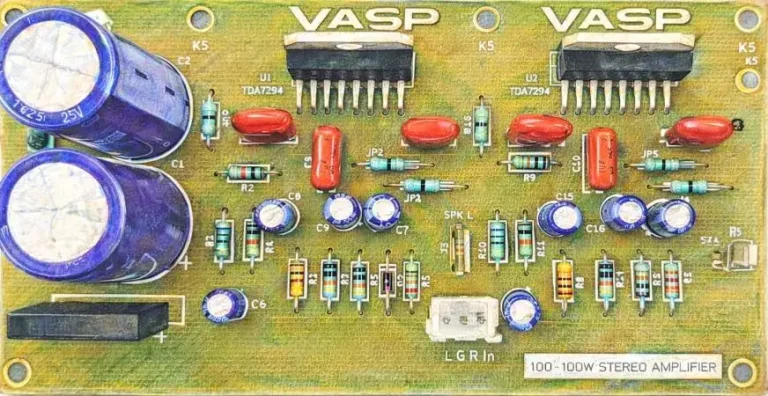
This 100W + 100W stereo amplifier board is a discrete Class-AB design built using 2SC5200 and 2SA1943 power transistors. It is intended for users who want higher output power and a more serviceable amplifier compared to IC-based designs.
In practical use, this board is suited for DIY audio systems, home amplifiers, and applications where robust performance and repairability are important.
Core Design
The amplifier uses a complementary push-pull output stage:
- 2SC5200 (NPN) transistor
- 2SA1943 (PNP) transistor
Each channel has its own driver and output stage, allowing true stereo operation while sharing a common power supply.
Output Performance
- Up to 100W per channel under proper conditions
Actual output depends on supply voltage, speaker impedance, and thermal management.
Power Requirements
This board includes an onboard rectifier and filter capacitors, so it can be powered directly from a transformer without requiring an external DC power supply.
- Recommended transformer: 24-0-24 VAC
- Current rating: 5A to 8A
- Center-tapped secondary required
The onboard rectifier converts AC to dual-rail DC for amplifier operation. Using a transformer with insufficient current rating will result in voltage drop, distortion, and reduced output performance.
Speaker Compatibility
The amplifier supports both 4Ω and 8Ω speakers. Lower impedance increases current demand and heat generation.
Proper wiring and load matching are important to prevent damage.
Thermal Performance
This is a high-power amplifier, and thermal management is critical:
- Large heatsinks are required
- Use thermal compound for proper heat transfer
- Ensure good airflow around the heatsink
If transistor tabs are electrically connected, insulation must be used to prevent short circuits.
Signal and Grounding
The board accepts line-level input. Proper grounding techniques such as star grounding help reduce hum and noise.
Keep input wiring separate from power and speaker lines.
Applications
- DIY high-power stereo amplifiers
- Home audio systems
- Workshop or small venue sound systems
- Educational electronics projects
Overall Assessment
This amplifier board is a strong choice for users who want higher output power and a discrete design. Its main advantage is flexibility and serviceability, as individual components can be replaced if needed.
With proper transformer selection, power supply capacity, and adequate cooling, it delivers stable and reliable performance in medium to high-power audio applications.
FAQ
Does this board require an external DC power supply?
No. The board includes an onboard rectifier and filter capacitors, so it can be powered directly from a transformer.
What transformer is recommended for this amplifier?
A 24-0-24 VAC center-tapped transformer rated between 5A to 8A is recommended for proper operation.
Can this amplifier drive 4Ω speakers?
Yes. It supports both 4Ω and 8Ω speakers, but 4Ω loads increase current demand and heat.
Is heatsinking necessary?
Yes. Large heatsinks are required for the output transistors to handle high power operation safely.
Is this amplifier suitable for beginners?
It is suitable for users with basic electronics knowledge, especially those familiar with power supply and thermal design.
Can it be used for continuous high-power operation?
Yes, but only with proper transformer capacity, adequate filtering, and effective cooling.