Minimum order value ₹99.00 · Get 10% Off on Cart Value use Coupon code VASP10 · Free shipping over ₹999.00

Class D Audio Amplifier Review: Efficiency, Design and Practical Limits

Class D audio power amplifiers are frequently described as a compromise between sound quality and efficiency. This perception largely comes from early implementations rather than from the operating principle itself. In practical use, Class D amplification represents a fundamentally different method of power conversion rather than a simplified version of linear amplification.
Instead of reproducing the audio waveform through continuous device conduction, Class D amplifiers convert the audio signal into a high-frequency switching representation and reconstruct it at the output. This approach enables very high efficiency while still meeting modern audio performance expectations when implemented correctly.
Quick Review Verdict
Class D audio amplifiers represent one of the most efficient amplifier technologies available today. In practical systems they can deliver high output power while generating significantly less heat than traditional linear amplifiers.
Modern implementations provide audio performance suitable for most consumer and professional applications. Their primary strengths are efficiency, compact size, and high power density, though proper PCB layout, filtering, and EMI control remain critical for reliable operation.
Scope of This Review
This review examines Class D amplification from a practical system perspective, focusing on how the topology operates, why efficiency is high, and what real-world design constraints must be considered when implementing these amplifiers.
- System-level operation of Class D amplifiers
- Reasons for high efficiency and reduced heat generation
- Differences compared to traditional linear amplifier classes
- Output stage switching behavior
- Layout, power supply, and EMI considerations
Definition of a Class D Amplifier
A Class D amplifier is a switching audio power amplifier. The input audio signal is converted into a high-frequency pulse-width-modulated (PWM) waveform, and the output devices operate primarily in fully ON or fully OFF states rather than in a linear conduction region.
After switching, a low-pass output filter removes the high-frequency components and reconstructs an analog voltage and current waveform suitable for driving a loudspeaker.
Fundamental Source of High Efficiency
Switching Operation vs Linear Dissipation
In linear amplifiers, output devices dissipate significant power because voltage and current exist simultaneously across the device. In Class D amplifiers, switching devices ideally dissipate minimal power because they operate either with very low resistance when ON or with minimal current when OFF.
This switching operation dramatically reduces conduction losses and thermal dissipation compared to Class A or Class AB amplifiers.
Thermal and Mechanical Implications
Higher efficiency reduces heat generation. As a result, Class D amplifier systems can use smaller heatsinks and achieve higher output power within compact enclosures. This increased power density is one of the main reasons for the widespread adoption of Class D amplification.
Pulse-Width Modulation and Signal Encoding
Class D amplifiers encode audio information in the duty cycle of a switching waveform rather than directly reproducing voltage amplitude. The instantaneous pulse width corresponds to the audio signal level.
Many modern implementations use self-oscillating modulation techniques. In these systems the switching frequency is established by the feedback loop rather than by a fixed external oscillator, allowing dynamic adaptation to load and signal conditions.
Output Stage Implementation
Power MOSFET Switching Devices
Power MOSFETs are commonly used in the output stage because of their fast switching capability and low on-resistance. Device characteristics directly influence switching losses, distortion levels, and overall thermal performance.
Dead-Time Control
A short non-overlap interval known as dead-time is inserted between switching transitions to prevent both output devices from conducting simultaneously. Dead-time must be carefully controlled because excessive dead-time increases distortion while insufficient dead-time can increase device stress and heat generation.
Audio Performance Considerations
Early Class D amplifiers were limited by switching noise, poor filtering, and slow control loops. Modern designs address these issues using improved feedback systems, better output filter design, and precise switching control.
- High bandwidth feedback loops
- Improved LC output filter design
- Accurate dead-time control
- Carefully managed PCB current paths
With proper implementation, Class D amplifiers can deliver audio performance suitable for both consumer and professional sound systems.
Power Supply and PCB Layout Requirements
High di/dt Switching Currents
Class D amplifiers produce rapid current transitions during switching. Local decoupling capacitors and minimized current loop areas are essential to prevent switching noise from affecting sensitive signal paths.
Grounding and Return Paths
Signal ground and high-current switching paths must be carefully separated and controlled. Poor grounding strategies frequently lead to instability, audible noise, or electromagnetic interference.
Protection and Reliability Mechanisms
Most modern Class D amplifiers include integrated protection features such as over-current detection, undervoltage lockout, and controlled startup behavior. These features help protect output devices and loudspeakers during abnormal operating conditions.
Practical Limitations
Electromagnetic Interference
High-frequency switching inherently generates electromagnetic interference. Output filtering, controlled switching edges, and disciplined PCB layout are required to meet performance and regulatory constraints.
Design Sensitivity
Compared to linear amplifiers, Class D designs are more sensitive to PCB layout and component selection. Achieving high efficiency and stable operation requires careful system design.
Application Suitability
Class D amplifiers are especially suitable in applications where efficiency, compact size, and high output power are important.
- Portable and battery-powered audio systems
- Compact home audio equipment
- High-power subwoofer amplifiers
- Automotive and professional audio systems
Advantages
- Very high efficiency compared to linear amplifier classes
- Lower heat generation and smaller heatsinks
- High power output from compact designs
- Well suited for portable and high-power systems
Limitations
- Sensitive to PCB layout and grounding quality
- Requires proper output filtering
- EMI management is essential
- Design complexity is higher than linear amplifiers
Final Review Verdict
Class D amplification has evolved into a mature and highly efficient audio amplification technology. When implemented correctly, it provides strong performance, high efficiency, and excellent power density.
For applications where heat generation, energy efficiency, and compact design are important, Class D amplifiers are often the most practical choice. However, successful implementation requires careful attention to layout, filtering, and switching behavior.
Products Offered by VASP Electronics
The following Class D audio amplifier boards and modules are offered by VASP Electronics. These products are commonly used in compact audio systems, portable speakers, and high-efficiency amplifier builds.
- TPA3116D2 Class D Stereo Audio Amplifier Board
- TPA3118 Class D Audio Amplifier Board
- TPA3116D2 2.1 Channel Class D Amplifier Board
- PAM8610 Class D Stereo Audio Amplifier Board
- TDA7498 Class D High Power Amplifier Board
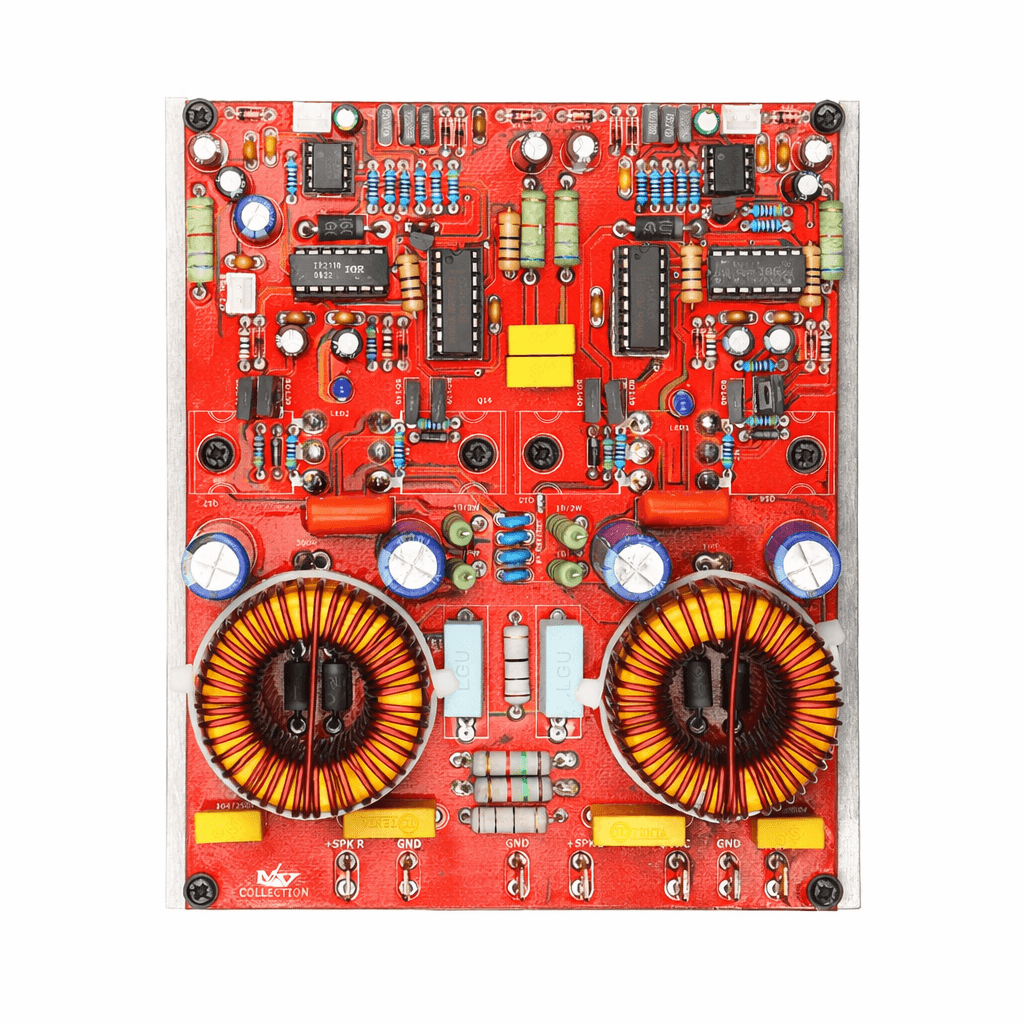
- IRS2092 Class D High Power Amplifier Board
Frequently Asked Questions
Does a Class D amplifier always require an output filter?
Yes. Most Class D amplifiers use a low-pass output filter to remove high-frequency switching components and reconstruct the audio signal before it reaches the loudspeaker.
Are Class D amplifiers more efficient than Class AB amplifiers?
Yes. Class D amplifiers typically achieve efficiencies above 85–90%, while linear Class AB amplifiers normally operate between 50–70% efficiency depending on operating conditions.
Do Class D amplifiers produce more noise?
Modern Class D amplifiers can deliver very clean audio performance. Noise problems usually occur only when PCB layout, filtering, or grounding are poorly implemented.
Why do Class D amplifiers generate less heat?
Class D output devices switch fully ON or OFF rather than operating in a linear region. Because voltage and current rarely exist simultaneously across the device, power dissipation and heat generation are significantly reduced.
Are Class D amplifiers suitable for subwoofer systems?
Yes. Their high efficiency and ability to deliver large amounts of power make them widely used in subwoofer amplifiers, home theater systems, and professional audio equipment.
What is the main limitation of Class D amplifier designs?
The main challenge is controlling switching noise and electromagnetic interference. Proper PCB layout, filtering, and grounding are essential for stable and clean operation.